
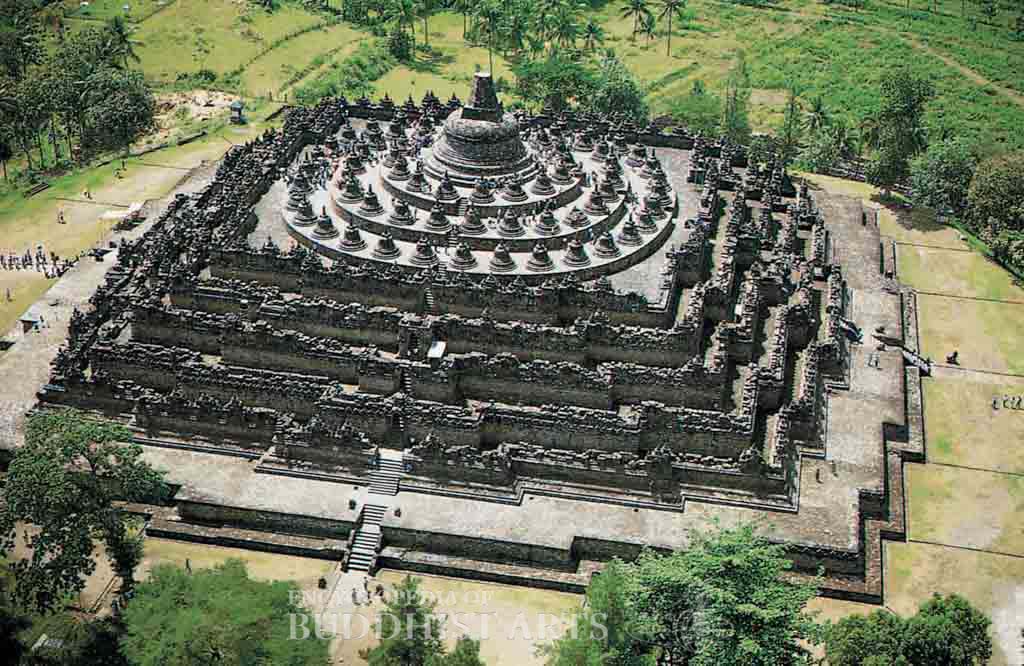
Borobudur (aerial view)
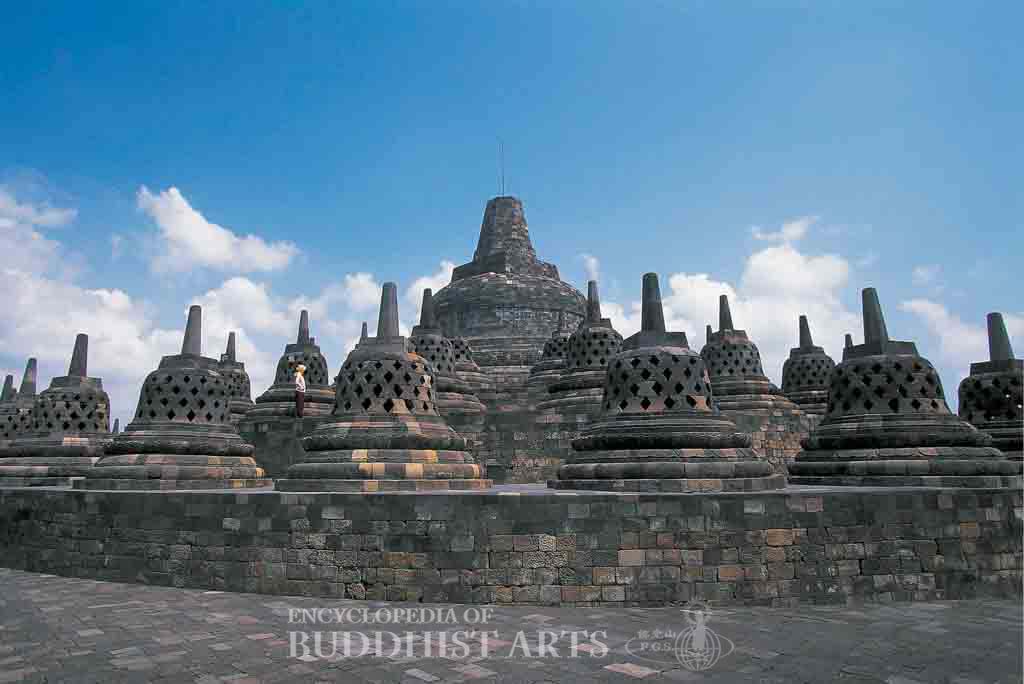
Borobudur: Stupas
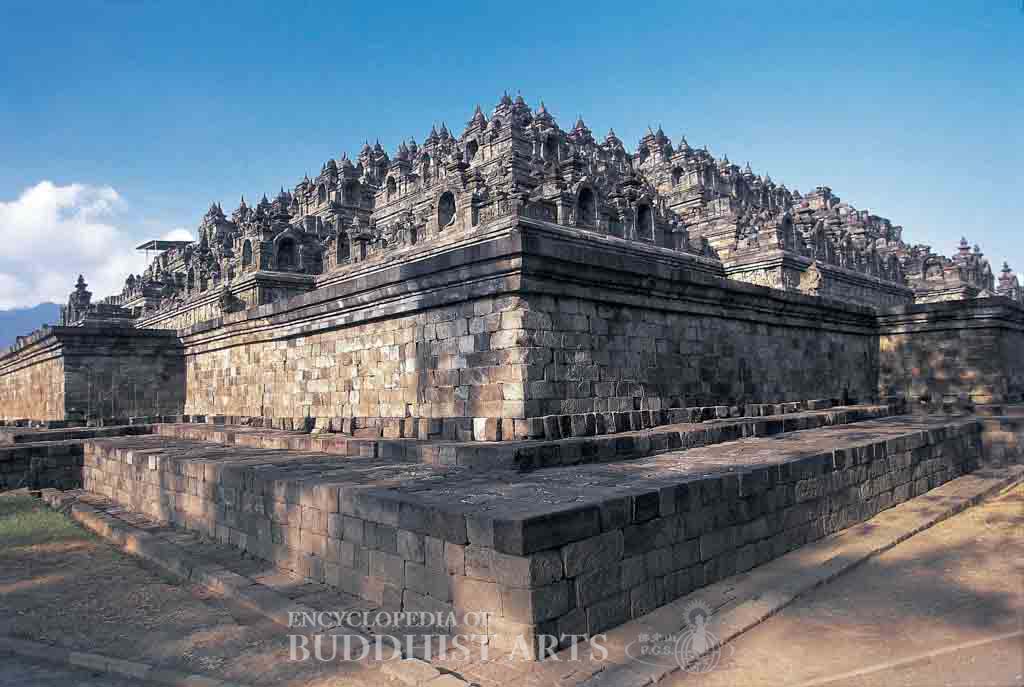
Borobudur
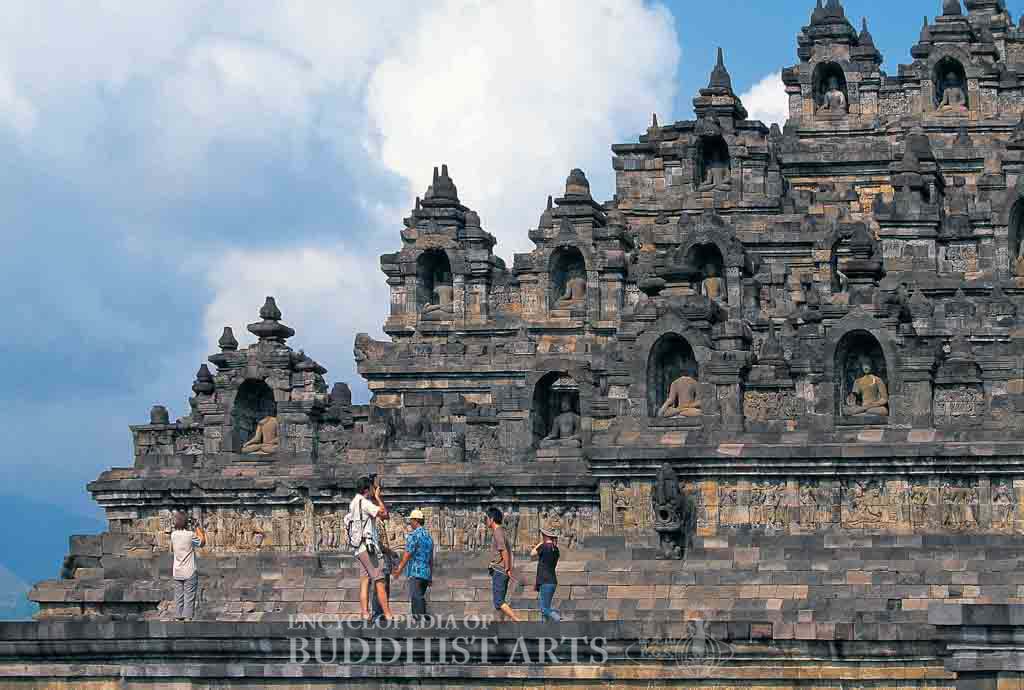
Borobudur: Buddha Niches
Borobudur
INDONESIA, Central Java, Magelang
The name Borobudur is believed to mean Monastery on the Hill. It has been suggested that its original name is Bhumi Sambhara Bhudhara (Mountain of Accumulation for the Stages). Borobudur is one of the greatest Buddhist monuments in the world. It was built by kings of the Sailendra dynasty (circa 750–850), using the labor of over 400,000 builders. Nearly two million pieces of volcanic rock were used in constructing this terraced, pyramidal Buddhist stupa complex. In 1006, when the volcano at Gunung Merapi (Fire Mountain) erupted, Borobudur was totally covered under a mound of volcanic ash. It remained buried and forgotten for the next 800 years. In 1814, British Lieutenant Governor Stamford Raffles discovered the hidden Borobudur complex and proceeded with archaeological excavations. However, after some initial discoveries, the uncovered site was backfilled and the excavation was abandoned. In 1973, a massive scale renovation project was carried out by the Indonesian government and UNESCO. This recovery project took ten years and cost 25 million US dollars. Borobudur was listed as a UNESCO World Heritage Site in 1991.
Occupying an area of 1.23 ha, Borobudur is situated on a hill and is composed of ten levels, including a two-tier base platform, five square terraces, and three concentric circular terraces. There are stairs placed in the middle of each side for ascending to each level. The overall square plan measures 123 m on each side. Originally reaching a height of 42 m, it was reduced to 31.5 m after the spire was struck by lightning. Consisting of a total of 504 Buddha statues of various sizes and over 2,670 relief panels of 6 km total length, the whole complex assumes the form of a gigantic, three-dimensional mandala. It is an embodiment of the merging of both Mahayana and Vajrayana Buddhism.
The entire structure can be divided into three realms of Buddhist cosmology from the bottom up: Kamadhatu (Realm of Desire), Rupadhatu (Realm of Form), and Arupadhatu (Realm of Formlessness). The base platform, representing Kamadhatu, is laid with 160 stone relief panels. These are enclosed by a stone wall and are called the hidden foot. These reliefs, based on the Karmavibhanga Sutra, depict teachings that admonish defilements and encourage right action.
The next five square terraces, symbolizing Rupadhatu, are decorated with Buddha niches and relief panels. The themes for these narrative panels include the Life of the Buddha based on the Lalitavistara Sutra; the past lives of the Buddha and other Bodhisattvas from the Jatakas and Avadanas; and Sudhana’s Search for the Ultimate Truth according to the Sanskrit text Gandavyuha Sutra, which became the last chapter of the Avatamsaka Sutra. There are a total of 432 Buddha niches each containing a seated Buddha. They are elegant, with hands held in the bhumisparsa (earth-touching) mudra, the dhyana (meditation) mudra, or the vitarka (teaching) mudra.
On the three circular terraces, representing Arupadhatu, there are 72 perforated, bell-shaped stupas. They are distributed in concentric rings on the circular terraces and each contain a seated Buddha statue. These stupas surround the central main stupa, which is in the shape of a huge dome with a spire. This culmination of the formless represents the highest state of cultivation, which is the enlightenment of a Buddha.
The reliefs and seated Buddha statues are delicately carved and vividly depicted, generally in the traditional Gupta style from India. Javanese influences can also be detected in the portrayal of the local costumes and accessories of figures on the reliefs.
For more details, go to the Encyclopedia of Buddhist Arts: Architecture A-F, page 92.
Cite this article:
author = Hsingyun and Youheng and Johnson, Peter and Mankuang and Lancaster, Lewis,
booktitle = {Encyclopedia of Buddhist Arts: Architecture A-F},
pages = 92,
title = {{Borobudur}},
volume = 1,
year = {2016}}