
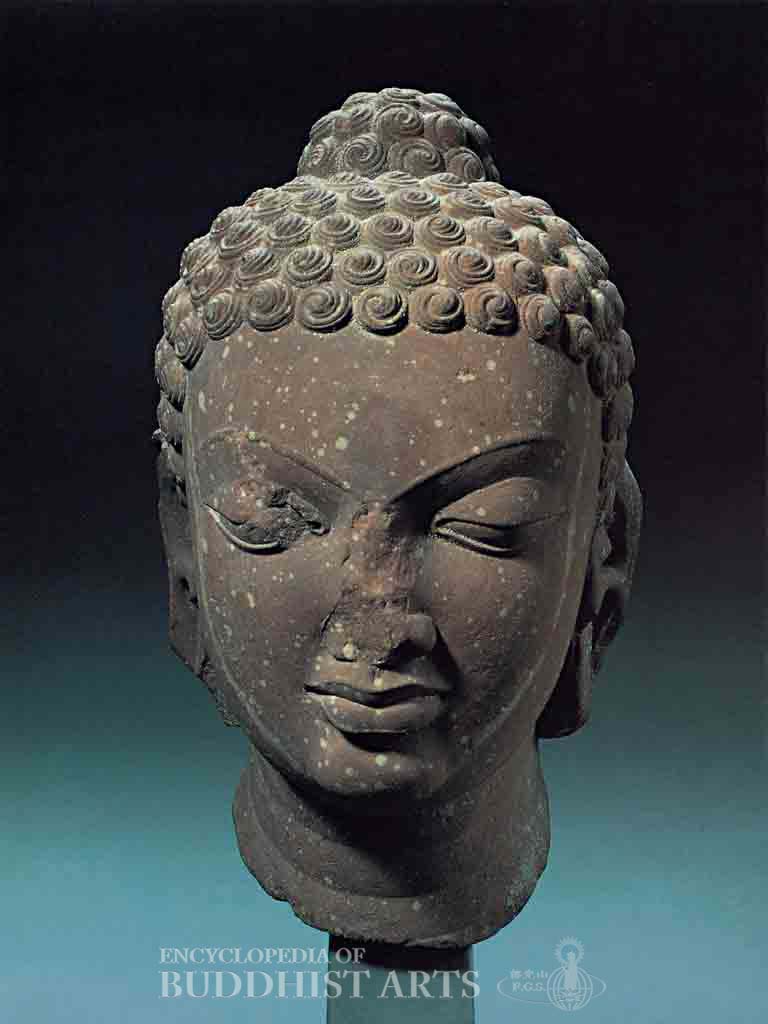
Mathura: Head of a Buddha
Sandstone
Mathura: Head of a Buddha
INDIA, Uttar Pradesh, Mathura
The sculpture was unearthed from Mathura. The Buddha’s tight, snail-shell curls are drawn into a small usnisa towards the back of the head. The facial features are delicately Indian, with a broad brow in which the eyebrows meet over the nose, beneath which are large almond-shaped eyes that gaze downward. Despite damage, the nose appears to have been broad and the mouth is bow-shaped and sharply defined. The elongated earlobes are broken. The neck has the three lines of a great person, which was a standard feature of Buddha statues prevalent during the Gupta period (circa 320–550). The style created a balance between the material and the spiritual and emphasized the bodily manifestation of spiritual qualities.
For more details, go to the Encyclopedia of Buddhist Arts: Sculpture G-M, page 694.
Cite this article:
author = Hsingyun and Youheng and Lovelock, Yann and Chou, Yuan and Huntington, Susan and Edson, Gary and Neather, Robert,
booktitle = {Encyclopedia of Buddhist Arts: Sculpture G-M},
pages = 694,
title = {{Mathura: Head of a Buddha}},
volume = 11,
year = {2016}}