
Lopburi: Four-Armed Avalokitesvara
Sandstone
Lopburi: Four-Armed Avalokitesvara
THAILAND, Lopburi
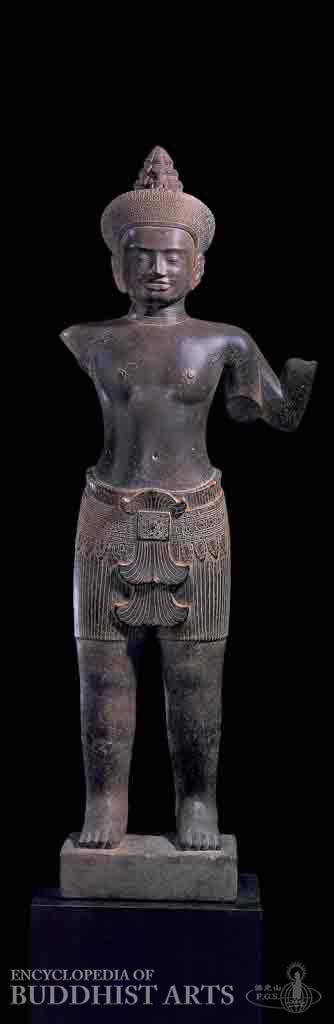
Excavated in Lopburi, the sculpture bears a striking resemblance to Baphuon artwork. Most likely it was of Khmer origin and brought to Thailand. The seated Amitabha on the topknot identifies the figure as Avalokitesvara.
The body is sturdy with a powerful chest, broad hips and compact legs. Despite damage, it is clearly four-armed and the hands may once have held other identifying attributes. The straight posture is common to statues of the Angkor period.
The tiered topknot is conical in shape. Apart from this, the figure is plain, which is a style typically seen before the era of King Jayavarman VII (reigned circa 1181–1220). The square face and its features are similar to that of the Baphuon style, with nearly joined eyebrows, almond-shaped eyes, and thick lips. The skirt worn by the figure is secured by an exquisite belt. The square buckle in the center with its lotus motif secures an anchor-like strap.
For more details, go to the Encyclopedia of Buddhist Arts: Sculpture G-M, page 642.
Cite this article:
author = Hsingyun and Youheng and Lovelock, Yann and Chou, Yuan and Huntington, Susan and Edson, Gary and Neather, Robert,
booktitle = {Encyclopedia of Buddhist Arts: Sculpture G-M},
pages = 642,
title = {{Lopburi: Four-Armed Avalokitesvara}},
volume = 11,
year = {2016}}