
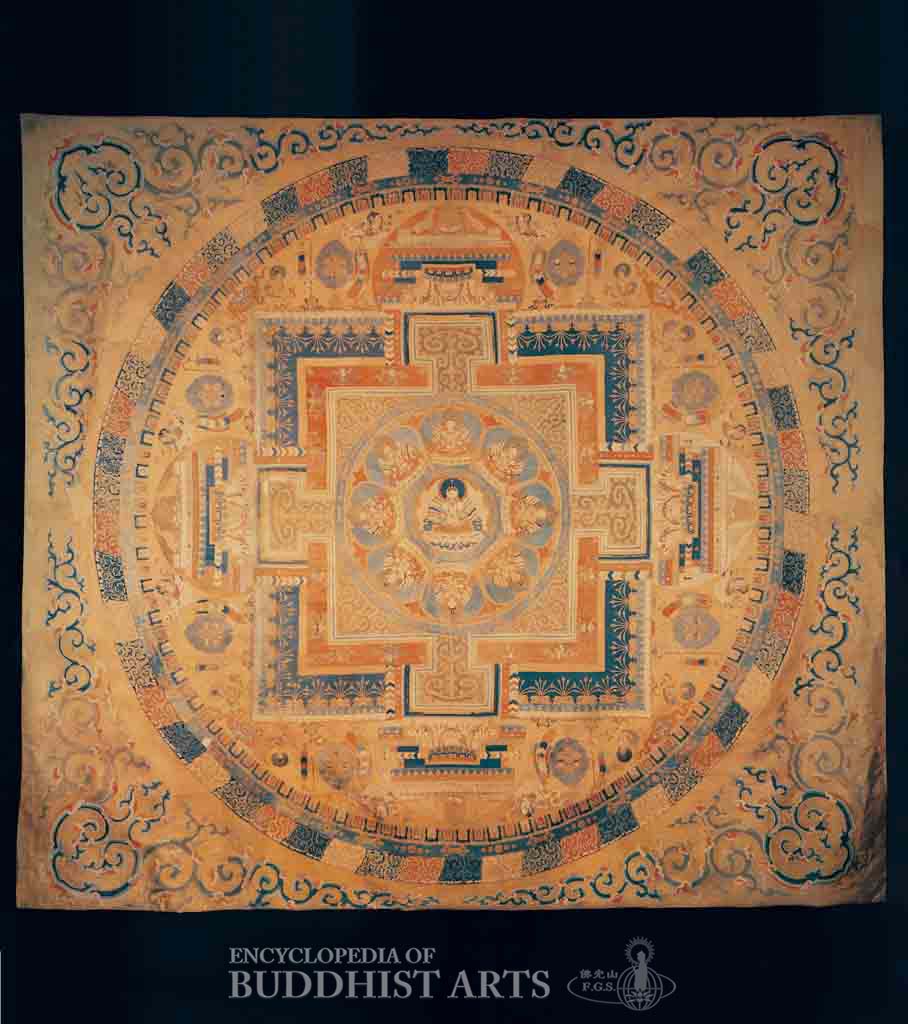
Embroidery of Womb Realm Mandala
Silk
Embroidery of Womb Realm Mandala
CHINA; Qing dynasty
It is thought that this 18th century embroidered silk mandala was presented to Emperor Yongzheng (reigned 1722–1735) of the Qing dynasty by a group of Mongolian nobles as an offering to a temple on Wutaishan.
The mandala is slightly wider than it is high. Vairocana Buddha sits in the center, symbolizing the sun, or the center of the universe. The eight lotus petals surrounding the Buddha, each have a seated Buddha or Bodhisattva. The entrances to the center of the mandala are T-shaped and there are four semicircular gateways in the outer section. These gateways are embroidered with Tibetan pavilions and decorated with various patterns, together with a pair of deer and a Dharma wheel on top of each pavilion. On either side of each pavilion are heavenly beings and auspicious symbols, such as a canopy, a vase, and a banner. The circle has representations of flames symbolizing karmic fire, vajras representing the power of compassion, and lotus petals signifying the path of the spiritual practitioner. Cloud motifs appear outside of the circle.
For more details, go to the Encyclopedia of Buddhist Arts: Artifacts, page 83.
Cite this article:
author = Hsingyun and Youheng and Youji and Pokorski, Stefanie and Mankuang and Fan, Wen,
booktitle = {Encyclopedia of Buddhist Arts: Artifacts },
pages = 83,
title = {{Embroidery of Womb Realm Mandala}},
volume = 18,
year = {2016}}