
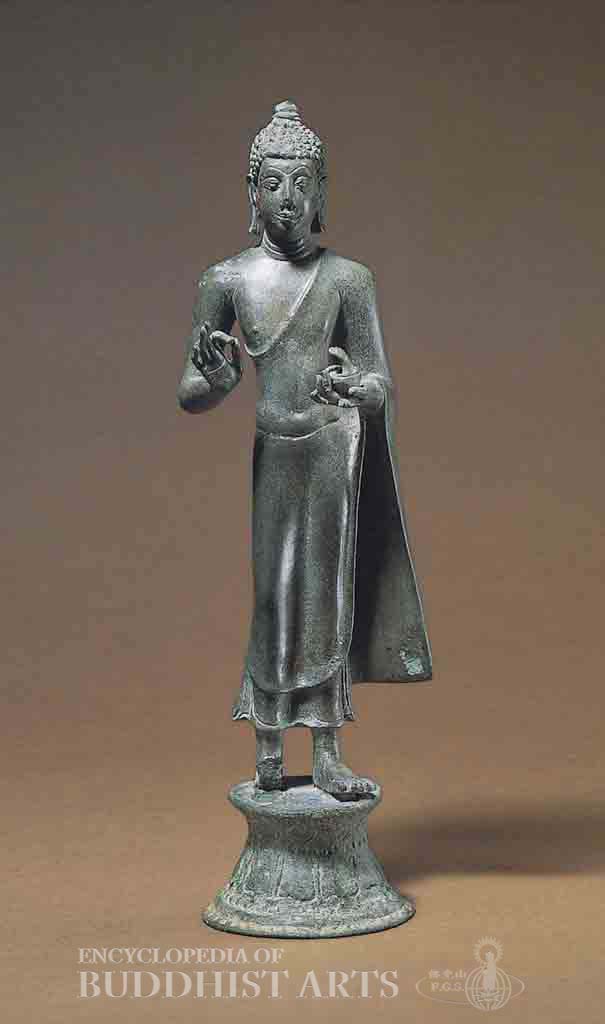
Java: Sakyamuni Buddha
Bronze
Java: Sakyamuni Buddha
INDONESIA, Java
The statue was unearthed from Java and created during the Central Java period (circa 7th–13th century). The figure’s long head is covered with dense curls and a damaged usnisa that may once have been topped with an ornament. The forehead is narrow, the hairline pulled almost down to the joined eyebrows. The slender body is covered with a thin monastic robe that leaves the right shoulder bare. The figure is in the action of walking forward, the action clearly seen by the shape of the legs underneath the garment. The right hand is raised in vitarka (teaching) mudra, while the left hand holds a small alms bowl from which a snake is rising. This has been interpreted as representing the story of how the Buddha converted the three Kasyapa brothers by defeating the naga that they worshipped.
For more details, go to the Encyclopedia of Buddhist Arts: Sculpture G-M, page 486.
Cite this article:
author = Hsingyun and Youheng and Lovelock, Yann and Chou, Yuan and Huntington, Susan and Edson, Gary and Neather, Robert,
booktitle = {Encyclopedia of Buddhist Arts: Sculpture G-M},
pages = 486,
title = {{Java: Sakyamuni Buddha}},
volume = 11,
year = {2016}}