
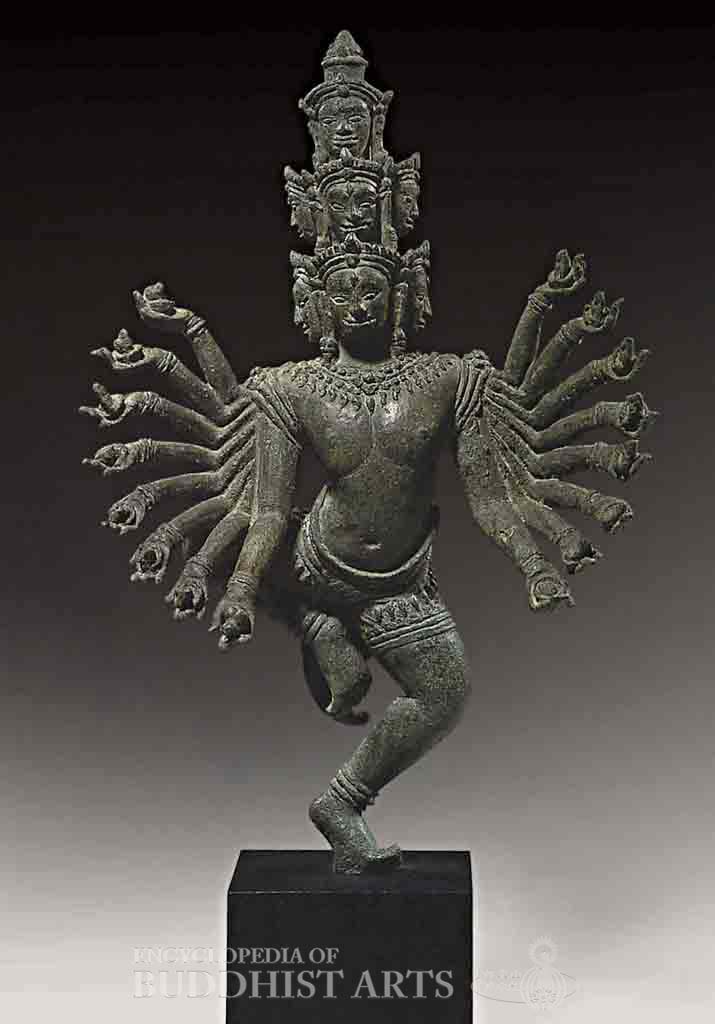
Hevajra
Bronze
Hevajra
CAMBODIA
The statue dates from the rule of King Jayavarman VII (reigned circa 1181–1220). The figure, with its seven visible heads and sixteen arms, balances upon a single sturdy leg with the other leg drawn up to the waist in a dancing posture that was popular during the period. The crowned heads rise in three tiers, each with a third eye in mid forehead. The figure also wears long earrings and an elaborate necklace with leaf decorations, as well as a leafy belt. The arms are splayed out in a fan-shape about the body. The hands on the left side hold objects that represent earth, water, air, fire, moon, sun, Yama, and the deity of wealth. The hands on the right hold the skullcaps of an elephant, horse, donkey, bull, camel, human, lion and cat. Holding these objects symbolize Hevajra’s universal power.
For more details, go to the Encyclopedia of Buddhist Arts: Sculpture G-M, page 428.
Cite this article:
author = Hsingyun and Youheng and Lovelock, Yann and Chou, Yuan and Huntington, Susan and Edson, Gary and Neather, Robert,
booktitle = {Encyclopedia of Buddhist Arts: Sculpture G-M},
pages = 428,
title = {{Hevajra}},
volume = 11,
year = {2016}}