
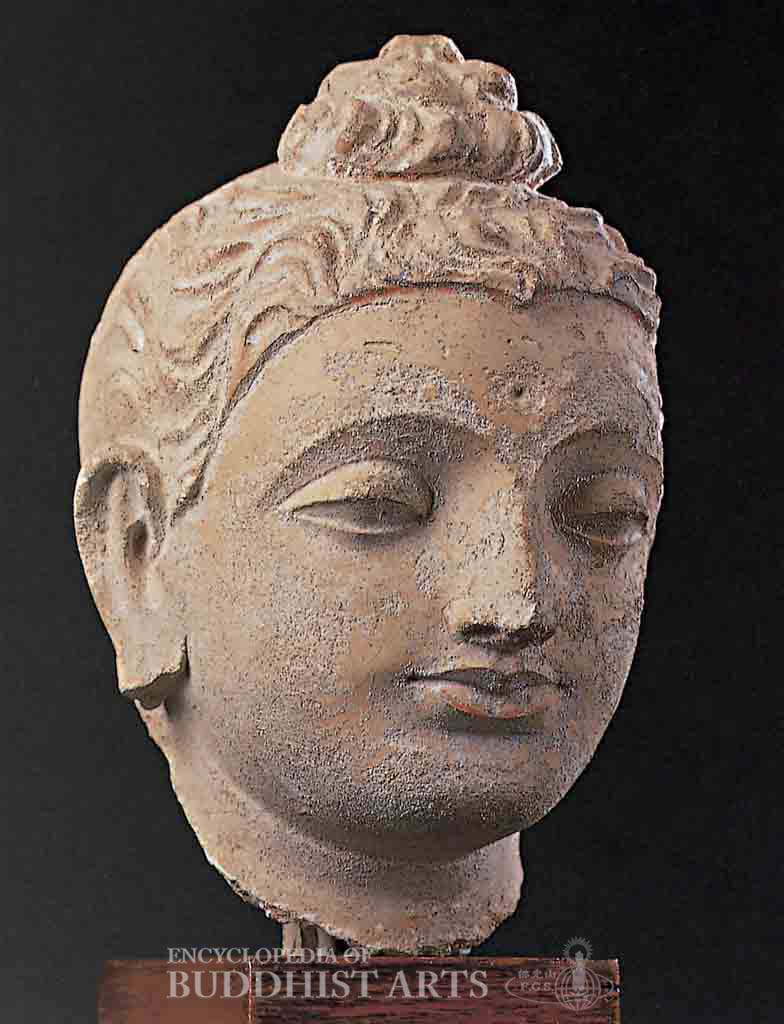
Hadda: Head of a Buddha
Plaster
Hadda: Head of a Buddha
AFGHANISTAN, Nangarhar, Jalalabad
The sculpture represents the traditional style seen in Gandharan sculptures. The figure’s wavy hair is combed back from the broad forehead and is confined in a small rounded topknot. Long, hooded eyes gaze compassionately ahead. The nose above the expressive lips is well-defined but small. There are still traces of vermilion paint around the lips and along the hairline. A mark above the eyebrows indicates where the urna was once present. Most Gandharan statues created in the 5th century were made from plaster. The superb craftsmanship of the sculptors who worked with nothing more than simple tools such as bamboo combs and knives is well exemplified here.
For more details, go to the Encyclopedia of Buddhist Arts: Sculpture G-M, page 408.
Cite this article:
author = Hsingyun and Youheng and Lovelock, Yann and Chou, Yuan and Huntington, Susan and Edson, Gary and Neather, Robert,
booktitle = {Encyclopedia of Buddhist Arts: Sculpture G-M},
pages = 408,
title = {{Hadda: Head of a Buddha}},
volume = 11,
year = {2016}}