
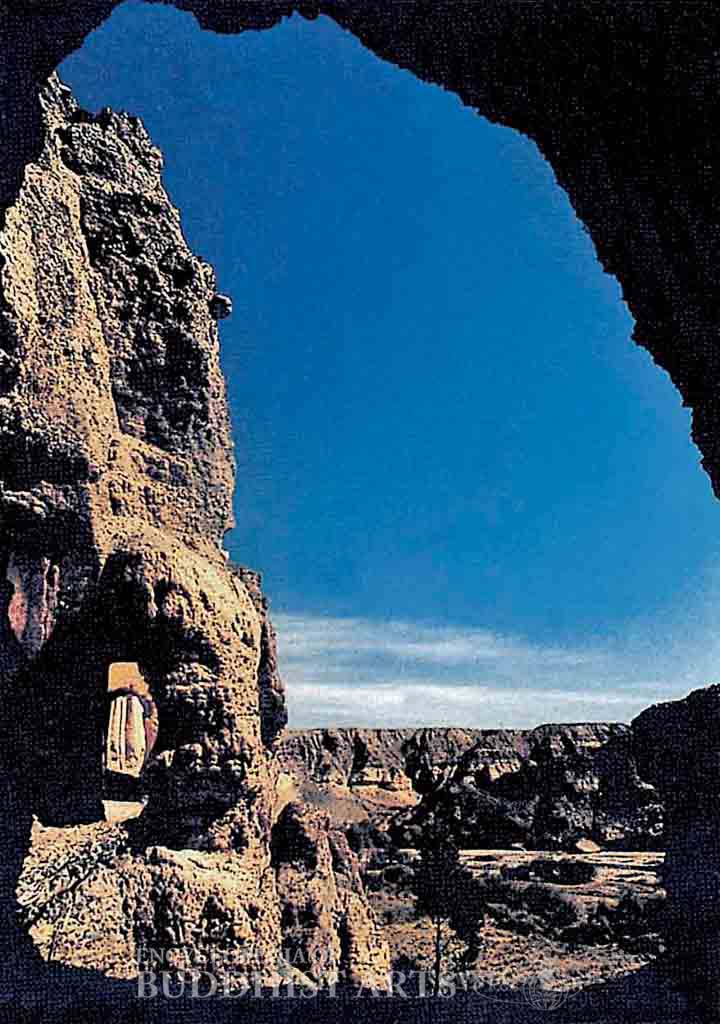
Five Temple Caves
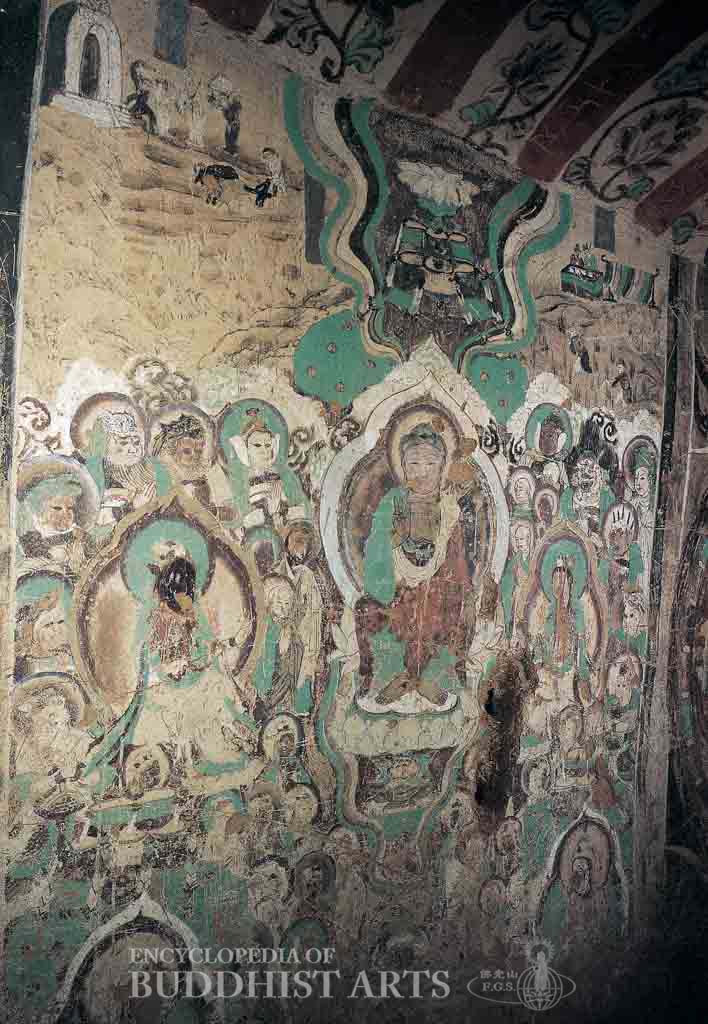
Five Temple Caves: Cave 1 - Illustration of the Sutra on the Descent of Maitreya
Five Temple Caves
CHINA, Gansu, Jiuquan
The Five Temple Caves are located on the cliff face of the Danghe River, 20 km northwest of Subei, Jiuquan. The name “Five Temple” derives from fact caves are referred to as temples by the Mongols. Despite the name, there are actually only four caves remaining at the site, and it is not entirely clear how many caves originally existed. Scholars have estimated that the caves were developed from the Northern Wei (386–534) to the Northern Song (960–1127) dynasty. They are listed as a Provincial Cultural Heritage Site.
Cave 1 is a central pillar cave containing numerous murals which include murals of Water-Moon Avalokitesvara, Tejaprabha Buddha, a mandala, the Twenty-Eight Mansions, the Twelve Zodiac Signs, Manjusri, Samantabhadra, and illustration of the Maitreya Sutras. Cave 2 has been damaged so badly by smoke that it is impossible to distinguish the images. Cave 3 features Vajrayana themes, with murals of Sixteen-Armed and Four-Armed Avalokitesvara Bodhisattvas, as well as illustrations of the Vimalakirti Sutra, the Maitreya Sutras, the Medicine Buddha Sutra, and the Battle Between Sariputra and Raudraksa. The murals within Cave 4 include an illustration of the Buddha Teaching the Dharma as well as images of Water-Moon Avalokitesvara, Manjusri, and Samantabhadra Bodhisattvas. Most of the murals are not original. They were restored or recreated during the Five Dynasties (907–960), Song dynasty (960–1279), Western Xia period (1032–1227), and Yuan dynasty (1271–1368).
For more details, go to the Encyclopedia of Buddhist Arts: Caves R-L, page 369.
Cite this article:
author = Hsingyun and Youheng and Johnson, Peter and Mankuang and Huntington, Susan and Edson, Gary and Neather, Robert,
booktitle = {Encyclopedia of Buddhist Arts: Caves R-L},
pages = 369,
title = {{Five Temple Caves}},
volume = 6,
year = {2016}}