
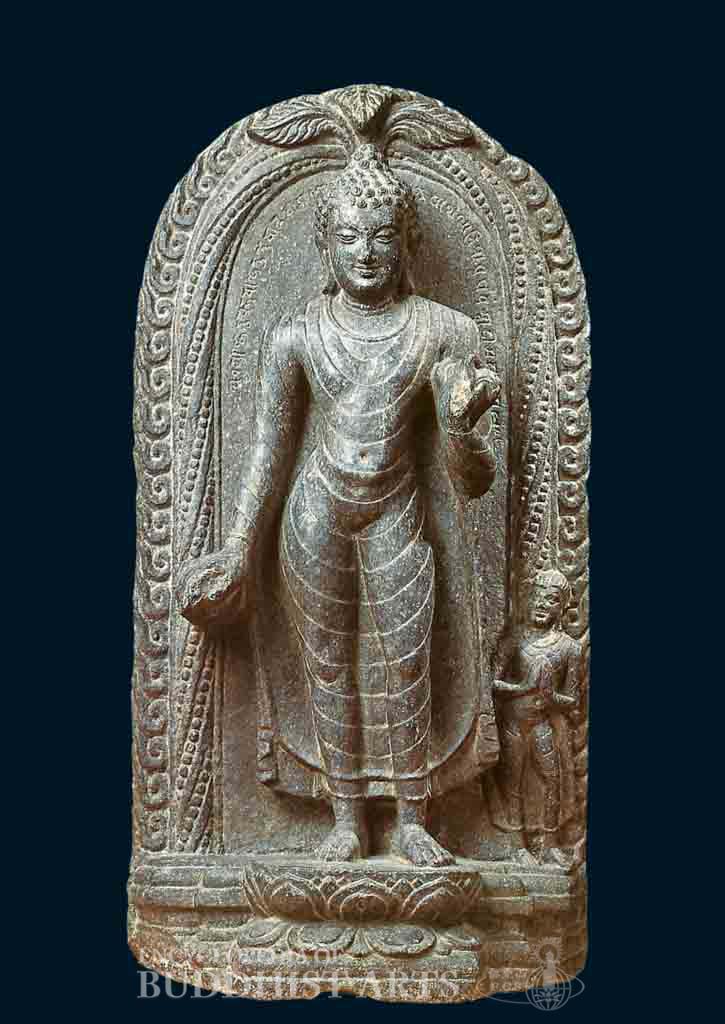
Nalanda: Standing Buddha
Black schist
Nalanda: Standing Buddha
INDIA, Bihar
The sculpture dates to the early Pala period (circa 8th–12th century) but the posture and monastic robe grow out of the earlier Sarnath style of the Gupta period (circa 320–550). The Buddha’s oval face has a pronounced chin, while his elongated earlobes brush the shoulders. The diaphanous robe falls in a pattern of concentric folds, adapting themselves to the shape of the body beneath. The advanced left foot forces the weight of the body onto the right leg and displaces the waist.
The overarching mandorla has three distinct borders. The Dharmakaya Gatha is inscribed in Sanskrit on the innermost border. The middle border features a flower garland, while around the outer are stylized flames. Three leaves form a canopy above. A small figure stands to the right with hands in anjali (reverence) mudra.
For more details, go to the Encyclopedia of Buddhist Arts: Sculpture N-Sr, page 751.
Cite this article:
author = Hsingyun and Youheng and Lovelock, Yann and Chou, Yuan and Huntington, Susan and Edson, Gary and Neather, Robert,
booktitle = {Encyclopedia of Buddhist Arts: Sculpture N-Sr},
pages = 751,
title = {{Nalanda: Standing Buddha}},
volume = 12,
year = {2016}}