
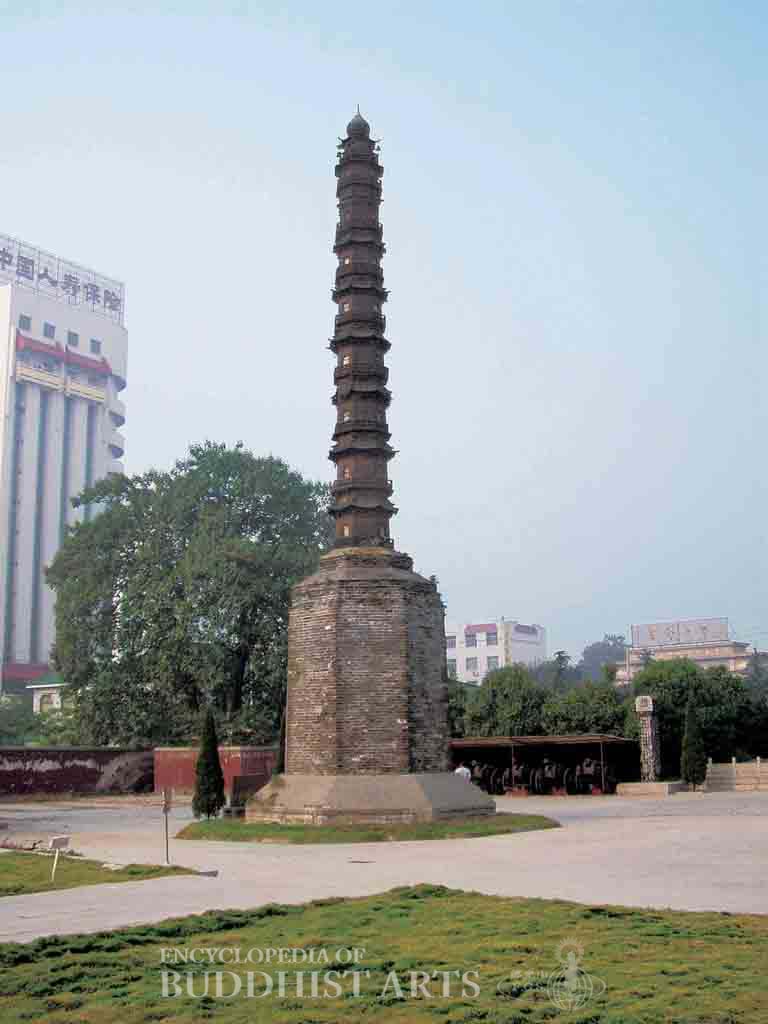
Chongjue Temple Iron Pagoda
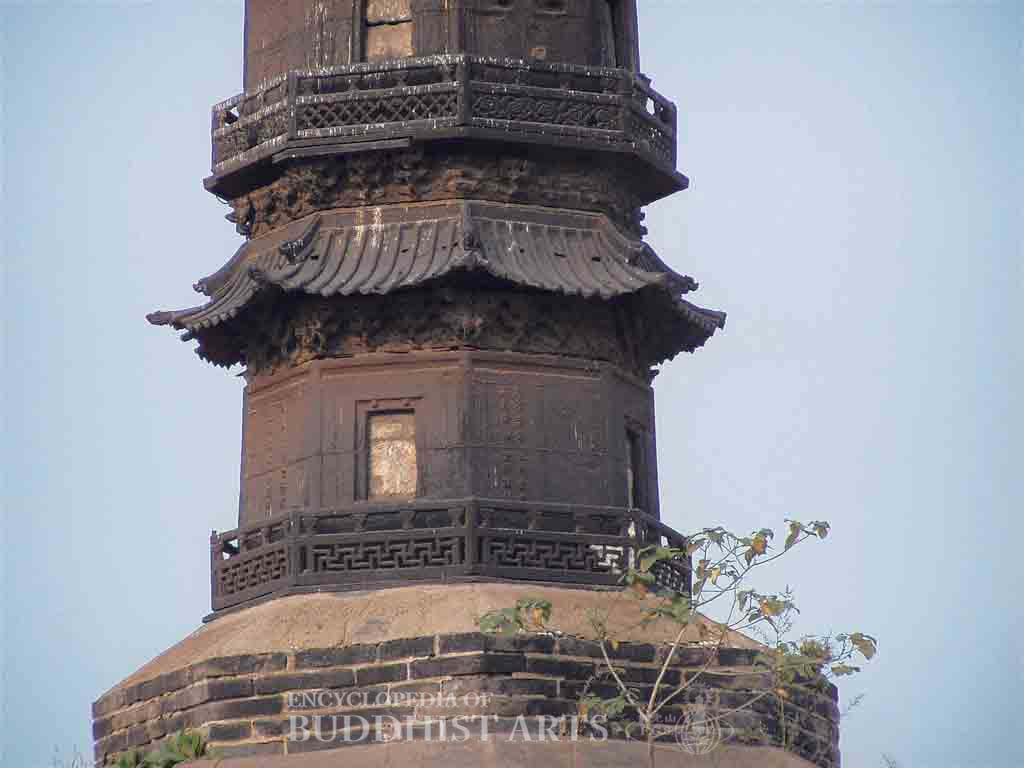
Chongjue Temple Iron Pagoda (detail)
Chongjue Temple Iron Pagoda
CHINA, Shandong, Jining
The temple is also known as Jining Iron Pagoda. The pagoda was built in 1105 during the Northern Song dynasty. An inscription on the pagoda body states that it was built by a woman to fulfill her husband’s wish. The pagoda originally consisted of seven tiers but they were increased to nine tiers after the renovation of 1581 during the Ming dynasty. It was listed as a National Cultural Heritage Site in 1988.
The octagonal iron pagoda is built in imitation of a timber building and is 23.8 m high. The 8.1 m high base is constructed from bricks. On the west side there is a doorway that leads to a chamber with an octagonal caisson ceiling. Each tier of the pagoda has a balcony formed by balustrades, whose panels are decorated with different patterns. False doors are located on the sides facing the four cardinal directions on each tier, while the remaining sides are decorated with Buddhist images. The eaves are supported by bracket sets. On the ninth tier wind chimes hang from each corner of the eaves. The spire consists of an inverted bowl and gilt bronze finial. The superb casting technique makes it a valuable example of this type of pagoda.
For more details, go to the Encyclopedia of Buddhist Arts: Architecture A-F, page 159.
Cite this article:
author = Hsingyun and Youheng and Johnson, Peter and Mankuang and Lancaster, Lewis,
booktitle = {Encyclopedia of Buddhist Arts: Architecture A-F},
pages = 159,
title = {{Chongjue Temple Iron Pagoda}},
volume = 1,
year = {2016}}