
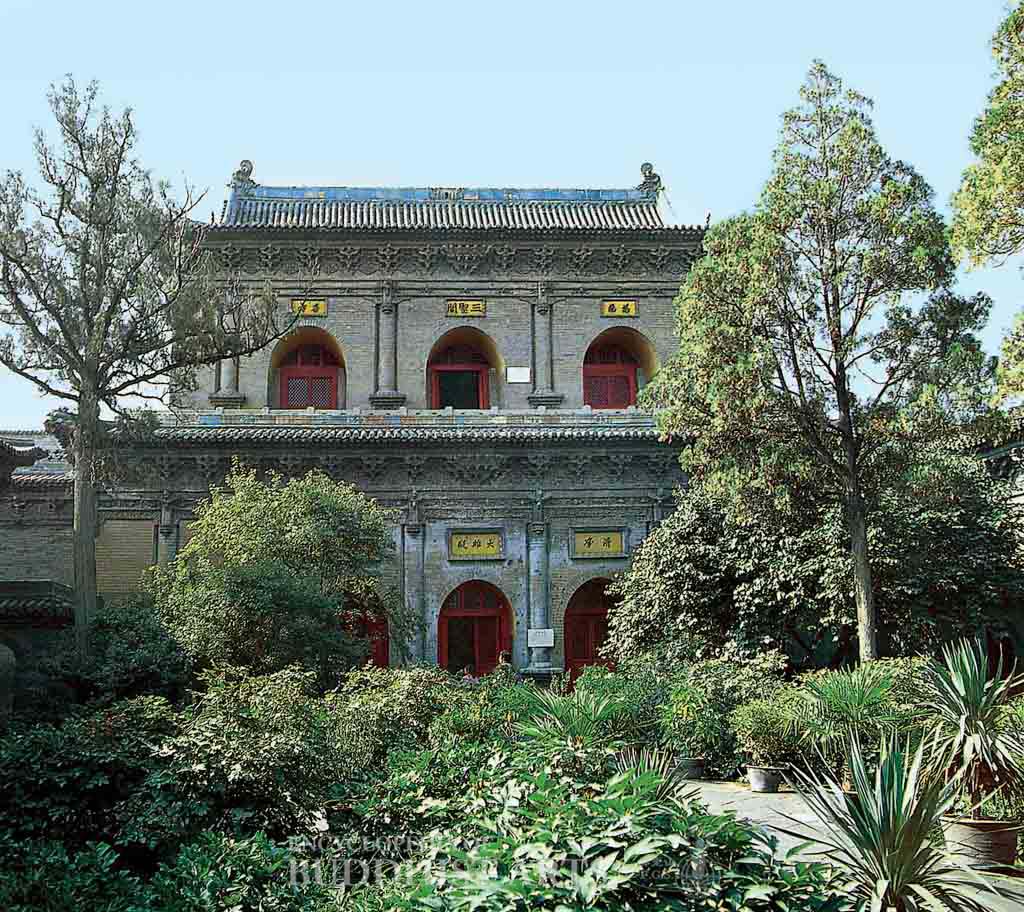
Yongzuo Temple: Great Hero Hall
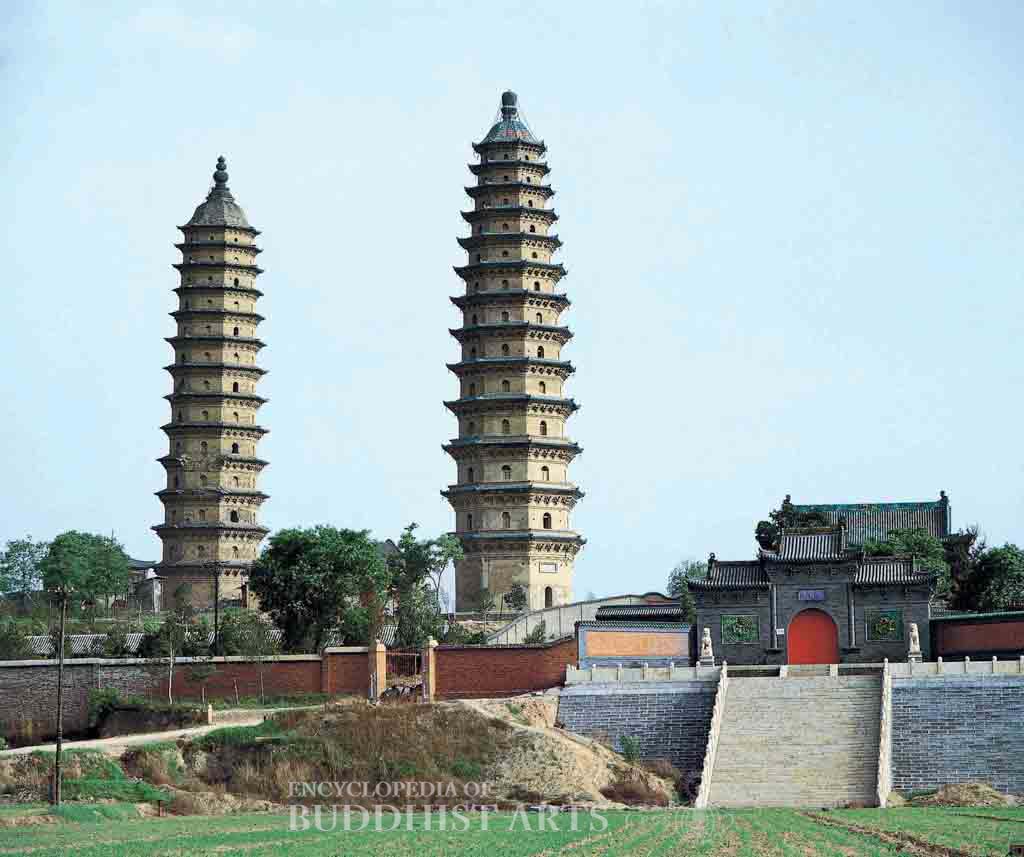
Yongzuo Temple: Twin Pagodas
Yongzuo Temple
CHINA, Shanxi, Taiyuan
Yongzuo stands for Eternal Blessing. It was built by the Master Fodeng under imperial order during the rule of Emperor Wanli (reigned 1573–1620) of the Ming dynasty. It was listed as a National Cultural Heritage Site in 2006.
The temple was built according to the contours of the hill and faces north. It consists of three compounds: the temple compound, the pagoda compound, and the stele compound. The temple compound is further divided into the front and rear sections. The front temple compound contains structures such as the main temple gate, subsidiary buildings, and the second and third gates. The buildings located within the rear temple compound are the Great Hero Hall, meditation hall, and abbot’s quarters. Within the pagoda compound are the twin pagodas, intermediate hall, and the rear hall. Most of the buildings are brick imitations of timber structures and were built during the Ming dynasty (1368–1644). The Great Hero Hall is two stories high and rectangular. The first story is five bays wide and contains the statues of Sakyamuni Buddha, Amitabha Buddha, and the Medicine Buddha. The upper story consists of the Hall of the Three Sages. It is three bays wide with a highly decorated vaulted ceiling in the central bay. The side bays are barrel-vaulted. The Great Hero Hall is a complete brick imitation of a wooden structure and has no beam framework. It is therefore also called the Beamless Hall. The side halls of the Great Hero Hall are five bays wide and single story, structurally similar to the Great Hero Hall.
Positioned at the highest location, the 13-story, octagonal twin pagodas are hollow inside and are 54.7 m high. The exterior of the pagodas is decorated with brick bracket sets, beams, and eaves. There are glazed decorations on the roof ridges. Arched doorways are located on every story with stairs providing access to the top.
The stele compound houses more than 260 stone steles. They range from the Ming dynasty to the Qing dynasty (1644–1911) and contain valuable calligraphic history.
For more details, go to the Encyclopedia of Buddhist Arts: Architecture T-Z, page 1363.
Cite this article:
author = Hsingyun and Youheng and Johnson, Peter and Mankuang and Lancaster, Lewis,
booktitle = {Encyclopedia of Buddhist Arts: Architecture T-Z},
pages = 1363,
title = {{Yongzuo Temple}},
volume = 4,
year = {2016}}