
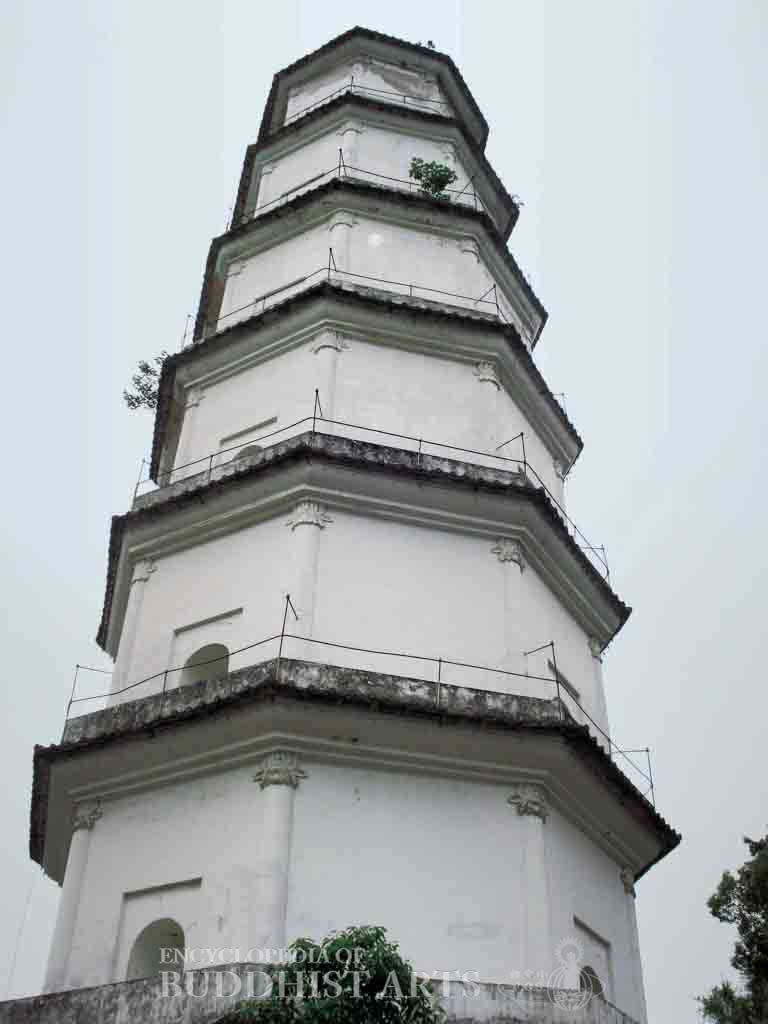
Dingguang Pagoda
Dingguang Pagoda
CHINA, Fujian, Fuzhou
Dingguang means Light of Calmness. Located in the western foothills of Yushan, the pagoda was built in 904 during the Tang dynasty. Emperor Taizu (reigned 862–925) of the Min dynasty built the pagoda to repay the kindness of his parents. Since it is painted white, it is also known as the White Pagoda. It was destroyed by fire in 1534 during the Ming dynasty, and was reconstructed in 1548 in its original Tang style. It was listed as a Provincial Cultural Heritage Site in 1991.
The seven-story, octagonal, brick pagoda is 41 m high. Originally, the pagoda body was built from brick, while its eaves were made from wood. During the reconstruction, a spiral wooden stairs leading to the roof was placed inside the hollow pagoda, resulting in its present form.
A three-legged bronze cauldron cast in 505 during the Liang dynasty can be found inside the pagoda. It features Fujian’s oldest inscriptions in bronze script.
For more details, go to the Encyclopedia of Buddhist Arts: Architecture A-F, page 240.
Cite this article:
author = Hsingyun and Youheng and Johnson, Peter and Mankuang and Lancaster, Lewis,
booktitle = {Encyclopedia of Buddhist Arts: Architecture A-F},
pages = 240,
title = {{Dingguang Pagoda}},
volume = 1,
year = {2016}}