
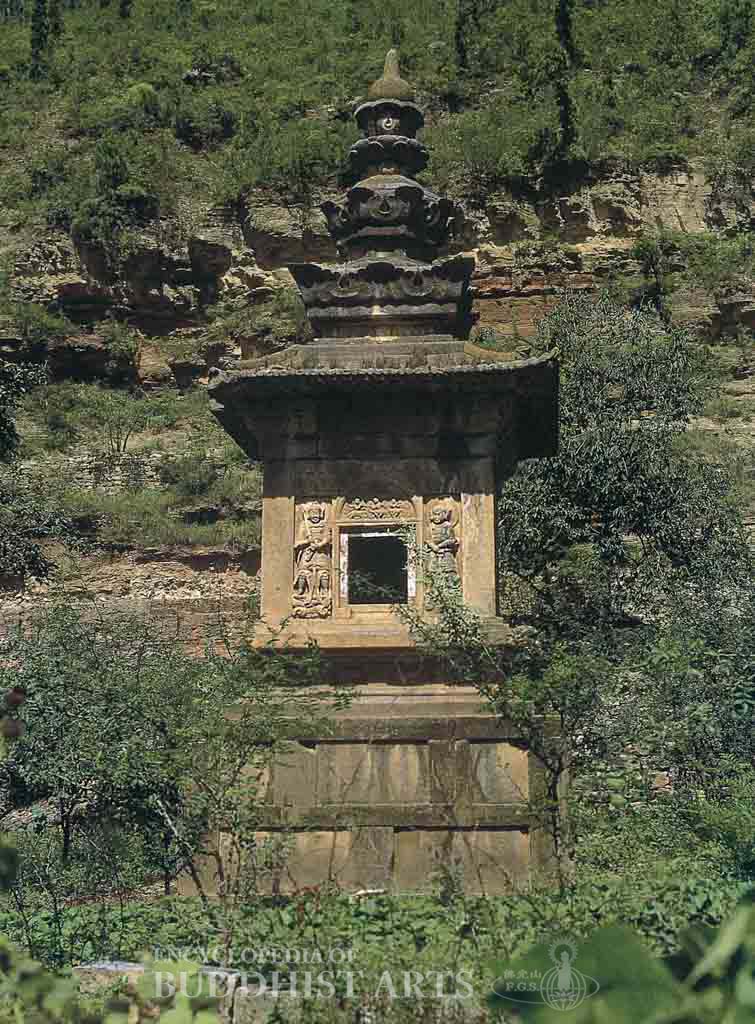
Haihui Yuan Temple Minghui Pagoda
Haihui Yuan Temple Minghui Pagoda
CHINA, Shanxi, Changzhi
Located within the ruins of Haihui Yuan Temple, the single-story pagoda was built in 877. Such single-story pagodas were popular during the Tang dynasty (618–907). It was listed as a National Cultural Heritage Site in 2001.
The square pagoda is 6 m high and constructed in stone. The two-layer base is 1.5 m high and is decorated with pilasters. A Sumeru throne carved with niches sits on top of the base. The pagoda body has a rectangular doorway on the south side guarded by a pair of Heavenly Kings. Reliefs of apsaras can be seen above the doorway. The eaves are extended and have slightly curved corners. The roof is shaped liked a truncated pyramid. The spire consists of four levels which are highly decorated with carvings of plantain leaves and lotus petals. Since it has a close resemblance to wooden Chinese structures, it provides a valuable source of information for the study of Chinese timber architecture.
For more details, go to the Encyclopedia of Buddhist Arts: Architecture G-L, page 425.
Cite this article:
author = Hsingyun and Youheng and Johnson, Peter and Mankuang and Lancaster, Lewis,
booktitle = {Encyclopedia of Buddhist Arts: Architecture G-L},
pages = 425,
title = {{Haihui Yuan Temple Minghui Pagoda}},
volume = 2,
year = {2016}}