
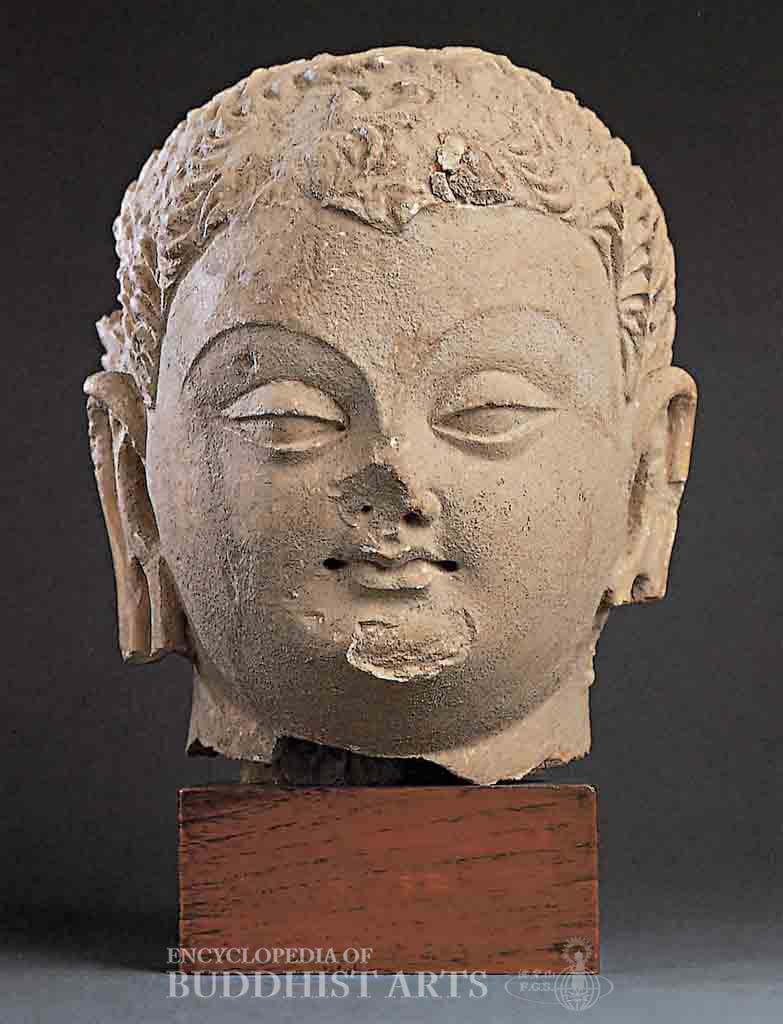
Dharmarajika Stupa: Head of a Buddha
Plaster
Dharmarajika Stupa: Head of a Buddha
PAKISTAN, Punjab, Taxila
The facial features clustered at the center of this Buddha’s head suggest that a mold may have been applied to the stucco. This technique is was in Gandhara and from there exported to Central Asia. The line of the finely arched eyebrows extends visibly into the center of the nose and the figure has a bow-like mouth. The figure has large, elongated ears that are hollowed, as if by heavy earrings. The ears lead experts to believe that the sculpture was from the Gupta period (circa 320–550).
For more details, go to the Encyclopedia of Buddhist Arts: Sculpture A-F, page 290.
Cite this article:
Hsingyun, et al. "Dharmarajika Stupa: Head of a Buddha." Encyclopedia of Buddhist Arts: Sculpture A-F, vol. 10, 2016, pp. 290.
Hsingyun, Youheng, Yann Lovelock, Yuan Chou, Susan Huntington, Gary Edson, and Robert Neather. 2016. "Dharmarajika Stupa: Head of a Buddha" In Encyclopedia of Buddhist Arts: Sculpture A-F, 10:290.
Hsingyun, Youheng, Lovelock, Y., Chou, Y., Huntington, S., Edson, G., & Neather, R.. (2016). Dharmarajika Stupa: Head of a Buddha. In Encyclopedia of Buddhist Arts: Sculpture A-F (Vol. 10, pp. 290).
@misc{Hsingyun2016,
author = Hsingyun and Youheng and Lovelock, Yann and Chou, Yuan and Huntington, Susan and Edson, Gary and Neather, Robert,
booktitle = {Encyclopedia of Buddhist Arts: Sculpture A-F},
pages = 290,
title = {{Dharmarajika Stupa: Head of a Buddha}},
volume = 10,
year = {2016}}
author = Hsingyun and Youheng and Lovelock, Yann and Chou, Yuan and Huntington, Susan and Edson, Gary and Neather, Robert,
booktitle = {Encyclopedia of Buddhist Arts: Sculpture A-F},
pages = 290,
title = {{Dharmarajika Stupa: Head of a Buddha}},
volume = 10,
year = {2016}}