
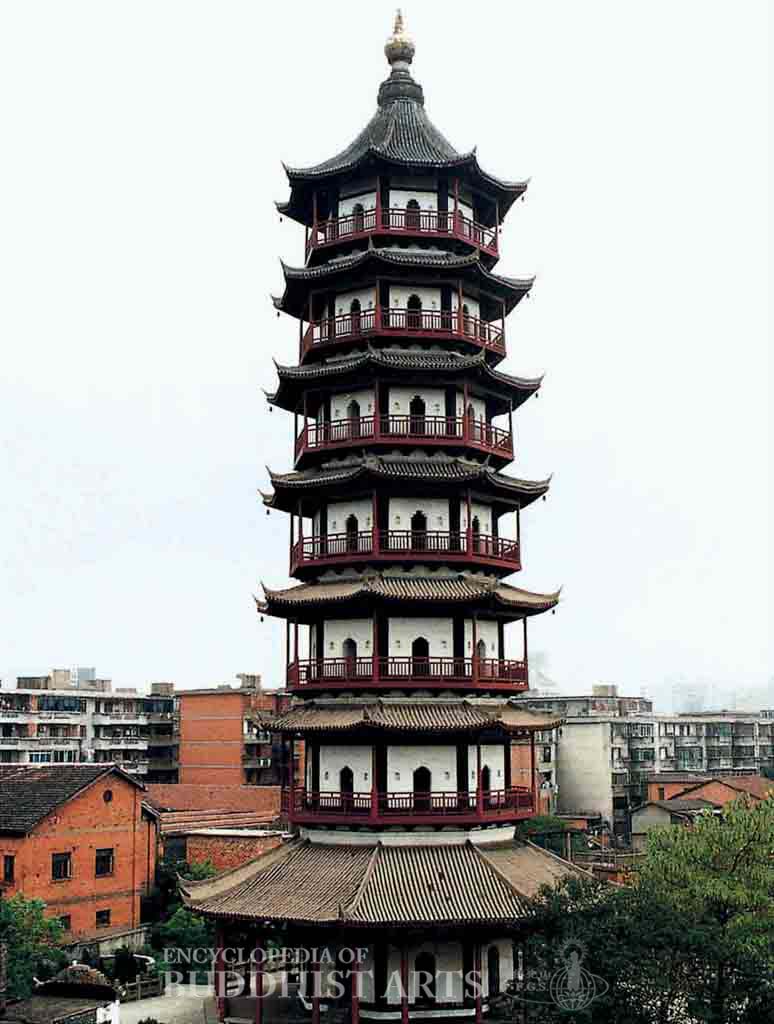
Shengjin Pagoda
Shengjin Pagoda
CHINA, Jiangxi, Nanchang
Shengjin means Golden Rope. The pagoda was constructed between 904 and 907 during the Tang dynasty. According to legend, workers laying the foundations for the pagoda dug up a metal container with four coils of golden rope, three old swords, and a golden reliquary containing 300 relics. The pagoda’s name is derived from this find. The pagoda has been destroyed and rebuilt a number of times throughout its history. It is listed as a Provincial Cultural Heritage Site.
The seven-story brick and timber pagoda is 50.9 m high. On the inside it has eight stories. While the building is octagonal on the outside, the inner chambers are square. The first story is surrounded by a veranda, while the remaining stories have balconies. On every story there are eight doors, half of which are real while the other half are decorative. The real and false doors alternate and their designs differ on every story. The roofs are covered in gray tiles and are turned up at the corners. The gourd-shaped spire is made from copper and shines in the sun.
For more details, go to the Encyclopedia of Buddhist Arts: Architecture M-S, page 979.
Cite this article:
author = Hsingyun and Youheng and Johnson, Peter and Mankuang and Lancaster, Lewis,
booktitle = {Encyclopedia of Buddhist Arts: Architecture M-S},
pages = 979,
title = {{Shengjin Pagoda}},
volume = 3,
year = {2016}}