
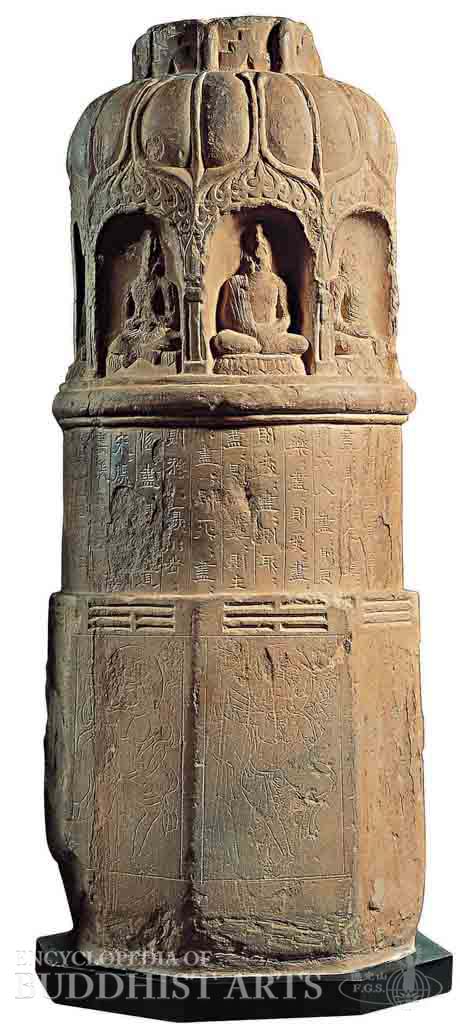
Gaochang: Stupa
Red sandstone
Gaochang: Stupa
CHINA, Xinjiang, Turpan; Northern Liang Kingdom
The stupa was excavated between the periods of 1902 to 1905 from the Buddhist ruins of Gaochang by the German explorer, Albert von Le Coq. Since then 14 more stone stupas dated to the Northern Liang dynasty (397–439) have been discovered in the Hexi Corridor as well as in Turpan.
Although the spire is missing, the remaining section is reasonably preserved, though worn. Each side of the octagonal base is incised with alternating male and female figures. Above each figure is a Bagua (Daoist eight diagrams) diagram, which are used to explain the Daoist cosmology. A slightly indented circular section above the base is inscribed with the Sutra of the Twelve Links of Dependant Origination, as well as the names of the donors, Song Qing, and his wife, Zhang. The upper section of the stupa is dome-shaped and contains eight ogee niches giving onto petal-shaped decorations above. Seven meditating Buddhas and a Bodhisattva, all of them in a poor state of repair are within the niches.
For more details, go to the Encyclopedia of Buddhist Arts: Sculpture G-M, page 372.
Cite this article:
author = Hsingyun and Youheng and Lovelock, Yann and Chou, Yuan and Huntington, Susan and Edson, Gary and Neather, Robert,
booktitle = {Encyclopedia of Buddhist Arts: Sculpture G-M},
pages = 372,
title = {{Gaochang: Stupa}},
volume = 11,
year = {2016}}