
Jing Si Abode
Jing Si Abode
TAIWAN, Hualien
In 1966, Cheng Yen, a bhiksuni at Puming Temple, founded the Buddhist Tzu Chi Merit Society, whose goal was to propagate the Dharma by doing charitable work and helping people in need. With the increase in membership, a larger site was needed. In 1968, with the financial help of Cheng Yen’s mother, a piece of land about 100 m from the old temple was bought and construction started. Jing Si Abode was completed the following year.
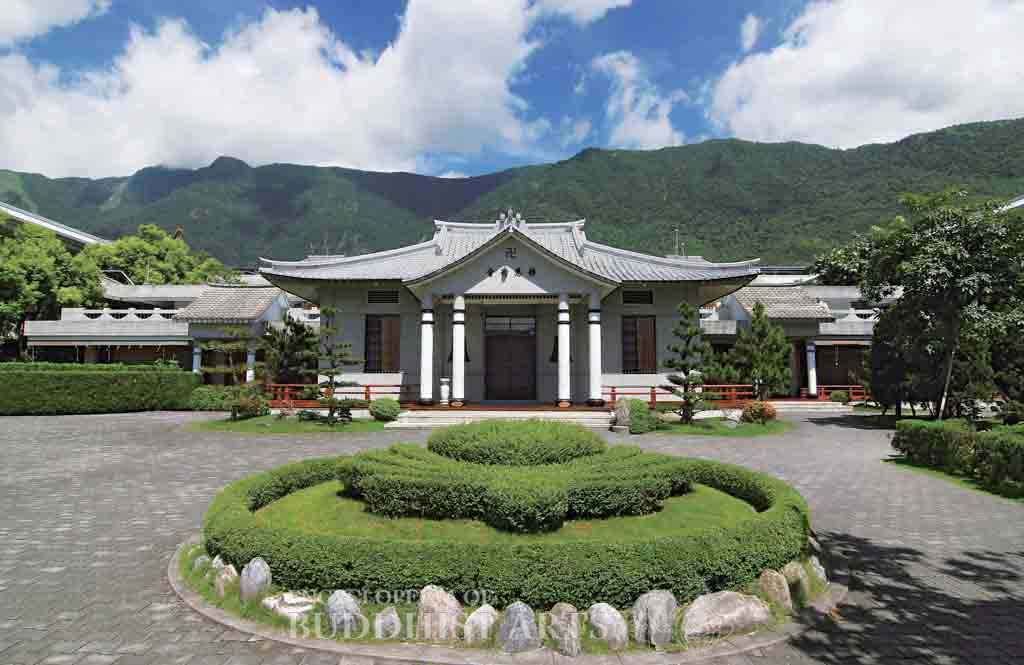
The principal buildings include the main hall, Avalokitesvara Hall and lecture hall. The main hall has a single-eave hip-and-gable roof with eaves that are upturned at the corners. The roof was originally covered with Japanese black tiles, which were replaced with concrete ones after sustaining damage from typhoons. There is a portico at the front. On either side of the door there are bell-shape windows. A statue of Sakyamuni Buddha is enshrined within the hall, with Ksitigarbha and Avalokitesvara Bodhisattvas on either side. The Jing Si Abode has become a symbol of the Tzu Chi Foundation all over the world. Every Tzu Chi building complex, whether a hospital or a university, has a Jing Si Hall designed in the likeness of Jing Si Abode.
For more details, go to the Encyclopedia of Buddhist Arts: Architecture G-L, page 521.
Cite this article:
author = Hsingyun and Youheng and Johnson, Peter and Mankuang and Lancaster, Lewis,
booktitle = {Encyclopedia of Buddhist Arts: Architecture G-L},
pages = 521,
title = {{Jing Si Abode}},
volume = 2,
year = {2016}}