
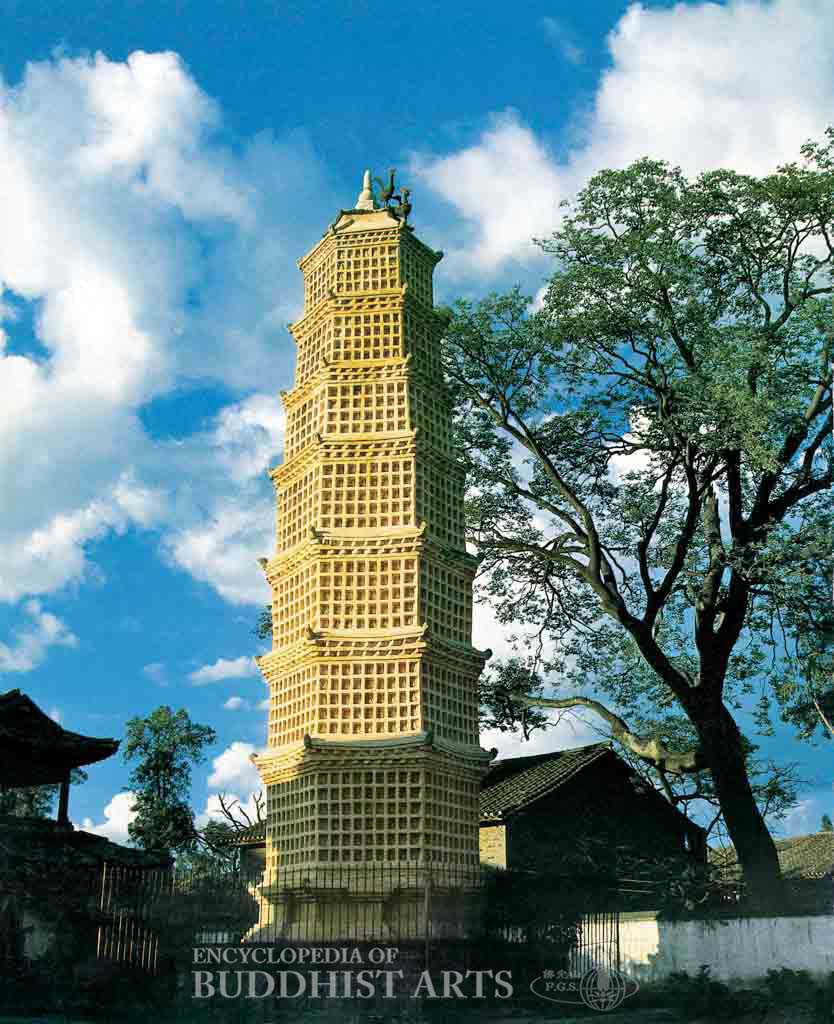
Dajue Temple Thousand Buddha Pagoda
Dajue Temple Thousand Buddha Pagoda
CHINA, Yunnan, Qujing
The pagoda was built during the early Yuan dynasty (1271–1368) and was repaired during the rule of Emperor Wanli (reigned 1573–1620) of the Ming dynasty. It was listed as a Provincial Cultural Heritage Site in 1983.
The seven-story, hexagonal, brick pagoda is about 18 m high. It has a Sumeru base. There are brick latticework niches covering every surface of the exterior with each containing a statue of Sakyamuni Buddha. Altogether there are 1,613 statues, from which it derives its name of Thousand Buddha Pagoda. The pyramidal roof is surmounted by a harmika, inverted bowl, and stacked rings. Two garudas, resembling the appearance of roosters, are located on the roof. Due to their presence, the pagoda is also called Jinji (Golden Rooster) Pagoda by local people. Designs like this are rare, with this being the only example in Yunnan.
For more details, go to the Encyclopedia of Buddhist Arts: Architecture A-F, page 207.
Cite this article:
author = Hsingyun and Youheng and Johnson, Peter and Mankuang and Lancaster, Lewis,
booktitle = {Encyclopedia of Buddhist Arts: Architecture A-F},
pages = 207,
title = {{Dajue Temple Thousand Buddha Pagoda}},
volume = 1,
year = {2016}}