
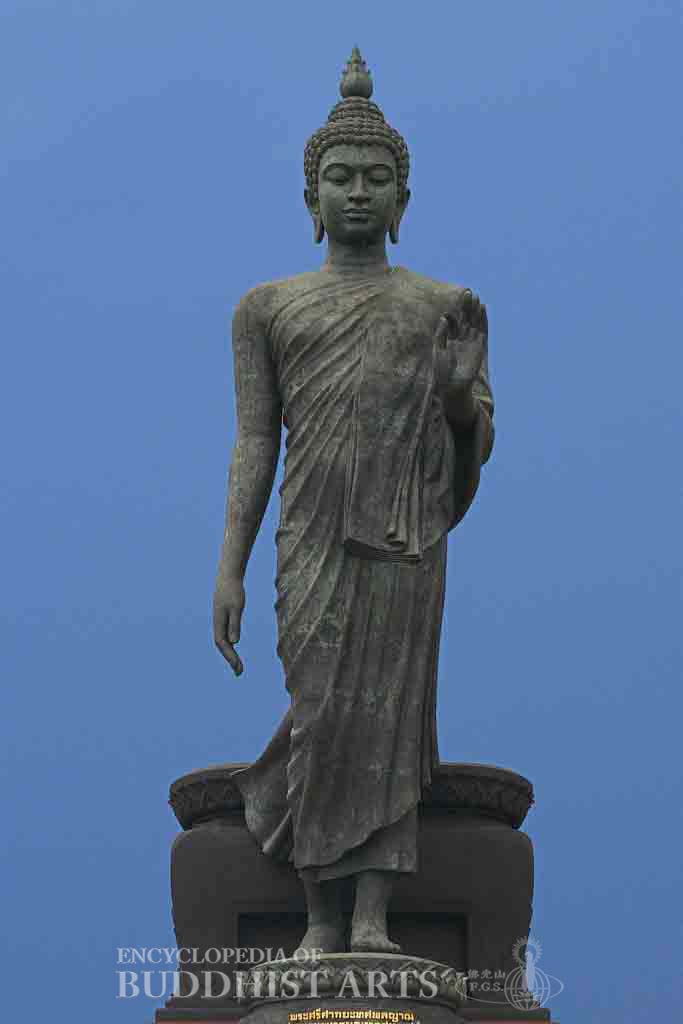
Buddhamonthon: Phra Si Sakkaya Thotsaphonlayan
Gilt copper alloy
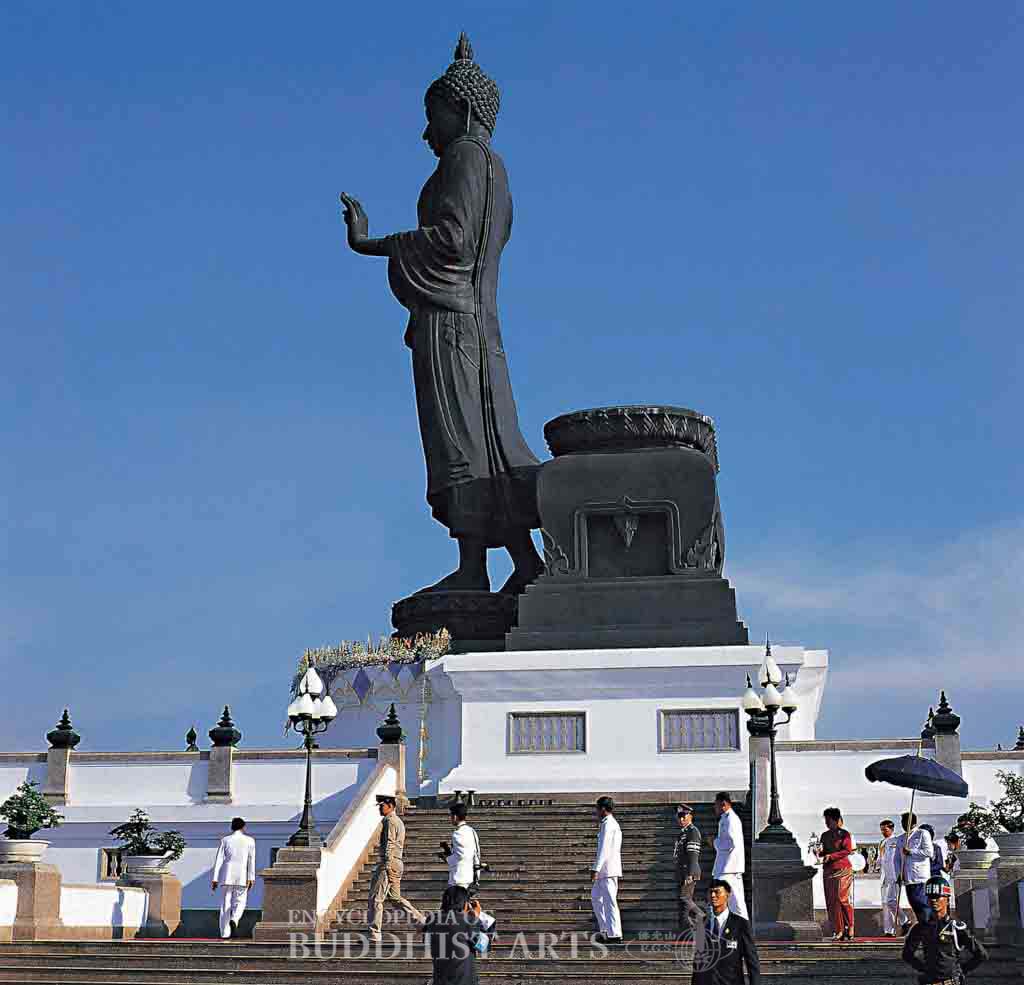
Buddhamonthon: Phra Si Sakkaya Thotsaphonlayan (side)
Phutthamonthon: Phra Si Sakkaya Thotsaphonlayan
THAILAND, Nakhon Pathom, Phutthamonthon
The world’s tallest walking Buddha is located in Phutthamonthon in Nakhon Pathom. This Buddhist site was built in 1955 by the Thai government and its people to commemorate the 2,500th anniversary of the founding of Buddhism. The inauguration ceremony was held in 1957 when the design of the statue was completed, but it was not cast until 1981. The statue is located at the center of a park and surrounded by four monuments relating to the Life of the Buddha: his birth, enlightenment, first turning of the Dharma wheel, and parinirvana.
The Buddha has tightly curled hair and a high usnisa surmounted by a flaming jewel. The left hand is raised in front of the shoulder in vitarka (teaching) mudra, while the right hand hangs naturally down by the side. The figure is depicted walking on a lotus pedestal with dignity and grace. The Buddha’s marks and walking posture have been adopted from the walking Buddha statues of the Sukhothai (circa 1238–1438) period. Other notable features are the facial structure and the realistic appearance of the folds on the robe, resulting in a sense of movement.
For more details, go to the Encyclopedia of Buddhist Arts: Sculpture N-Sr, page 815.
Cite this article:
author = Hsingyun and Youheng and Lovelock, Yann and Chou, Yuan and Huntington, Susan and Edson, Gary and Neather, Robert,
booktitle = {Encyclopedia of Buddhist Arts: Sculpture N-Sr},
pages = 815,
title = {{Phutthamonthon: Phra Si Sakkaya Thotsaphonlayan}},
volume = 12,
year = {2016}}