
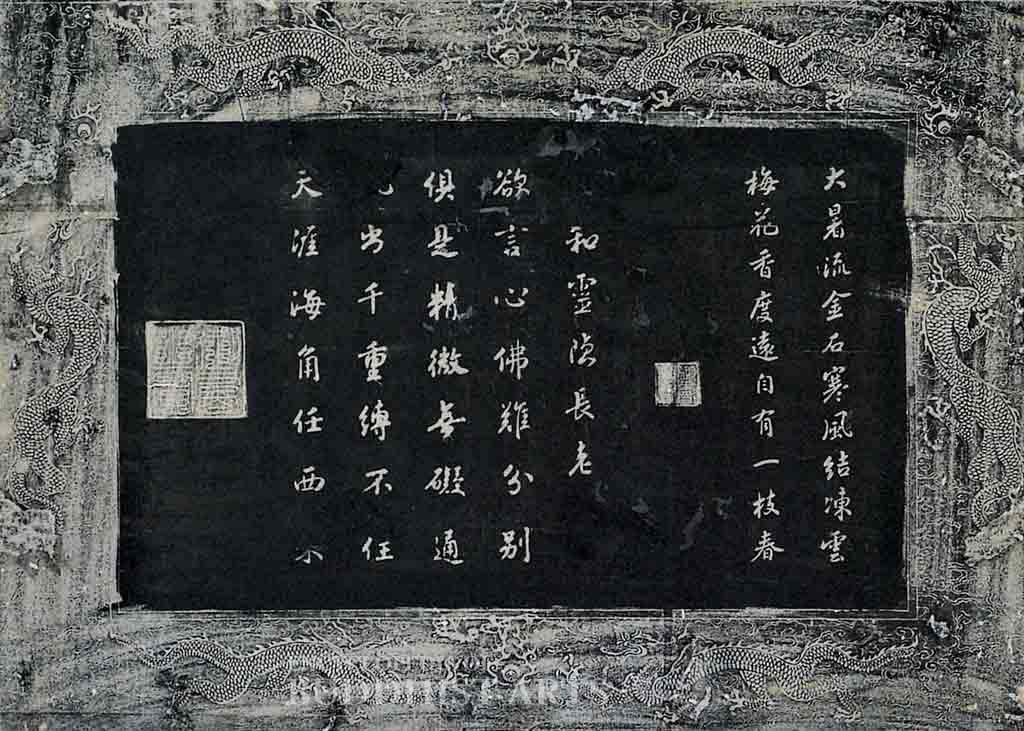
Verse by Emperor Xiaozong to Master Fozhao (detail)
Rubbing
Verse by Emperor Xiaozong to Master Fozhao
CHINA; Southern Song dynasty
This calligraphic work was one of the stele rubbings brought back to Japan from China by Master Enni Ben’en. According to the inscription, Emperor Xiaozong (reigned 1162–1189) of the Southern Song dynasty sent this poem to Chan Master Fozhao Deguang of Lingyin Temple in Zhejiang. The verse expresses the emperor’s thoughts on Chan, and an inscription by Master Fozhao at the bottom of the stele records the process of imperial conferment. The rubbing is listed as an Important Cultural Property of Japan.
Master Fozhao became a monk at the age of 22. He achieved sudden realization during a visit to Chan Master Dahui Zonggao in the Ayuwangshan (King Asoka Mountain) in Mingzhou (present day Ningbo). He received imperial instruction to serve as abbot of Lingyin Temple in 1176 during the Southern Song dynasty (1127–1279).
Emperor Xiaozong was the successor of Emperor Gaozong (reigned 1127–1162) of the Southern Song dynasty. He learned calligraphy, apart from a strong influence from his predecessor, by studying the styles of Wang Xizhi and Wang Xianzhi. The works of Master Zhiyong, particularly his Thousand Character Classic in Regular and Cursive Scripts, also influenced him. The brushwork in this piece has a soft and warm quality that resembles Emperor Gaozong’s style, and the spacious layout adds to the tranquil expressiveness of the calligraphy.
For more details, go to the Encyclopedia of Buddhist Arts: Calligraphy, page 267.
Cite this article:
author = Hsingyun and Youheng and Youlu and Pokorski, Stefanie and Mankuang and Edson, Gary,
booktitle = {Encyclopedia of Buddhist Arts: Calligraphy },
pages = 267,
title = {{Verse by Emperor Xiaozong to Master Fozhao}},
volume = 17,
year = {2016}}