
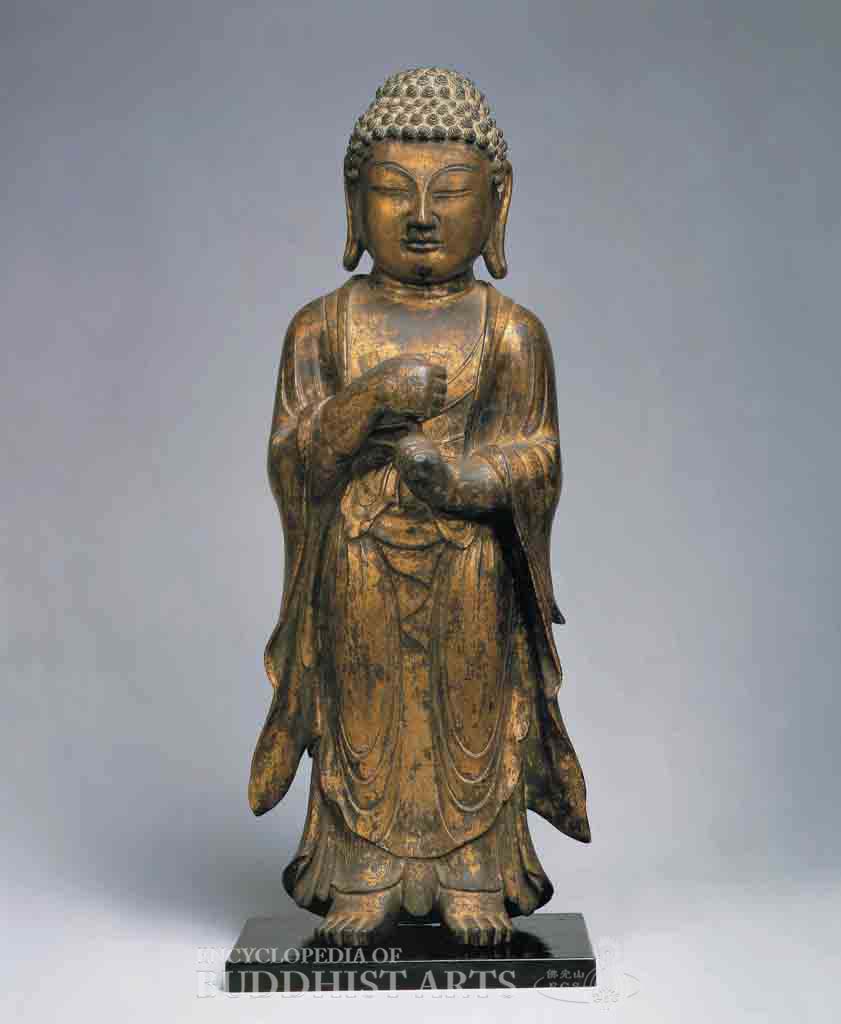
Vairocana Buddha
Gilt bronze
Vairocana Buddha
KOREA; Unified Silla dynasty
The statue was cast around the 9th century. The Avatamsaka Sutra became popular during the second half of the 7th century resulting in large numbers of Vairocana statues, of which the earliest known is dated to the second half of the 8th century. Most of the Vairocana Buddha figures from this period are in the bodhyangi (wisdom fist) mudra.
The figure has a mounded usnisa, elongated earlobes, and three lines on the neck. The monastic robe covers both shoulders with layers of folds draping down the body. The head is proportionately larger. The small holes in the back of the statue are evidence of the casting method.
For more details, go to the Encyclopedia of Buddhist Arts: Sculpture St-Z, page 1287.
Cite this article:
Hsingyun, et al. "Vairocana Buddha." Encyclopedia of Buddhist Arts: Sculpture St-Z, vol. 13, 2016, pp. 1287.
Hsingyun, Youheng, Yann Lovelock, Yuan Chou, Susan Huntington, Gary Edson, and Robert Neather. 2016. "Vairocana Buddha" In Encyclopedia of Buddhist Arts: Sculpture St-Z, 13:1287.
Hsingyun, Youheng, Lovelock, Y., Chou, Y., Huntington, S., Edson, G., & Neather, R.. (2016). Vairocana Buddha. In Encyclopedia of Buddhist Arts: Sculpture St-Z (Vol. 13, pp. 1287).
@misc{Hsingyun2016,
author = Hsingyun and Youheng and Lovelock, Yann and Chou, Yuan and Huntington, Susan and Edson, Gary and Neather, Robert,
booktitle = {Encyclopedia of Buddhist Arts: Sculpture St-Z},
pages = 1287,
title = {{Vairocana Buddha}},
volume = 13,
year = {2016}}
author = Hsingyun and Youheng and Lovelock, Yann and Chou, Yuan and Huntington, Susan and Edson, Gary and Neather, Robert,
booktitle = {Encyclopedia of Buddhist Arts: Sculpture St-Z},
pages = 1287,
title = {{Vairocana Buddha}},
volume = 13,
year = {2016}}