
Beshbalik Buddhist Temple S105 Shrine: Life of the Buddha - Distribution of Relics Among the Eight Kings
Beshbalik Buddhist Temple S105 Shrine: Life of the Buddha - Distribution of Relics Among the Eight Kings
CHINA, Xinjiang, Jimsar
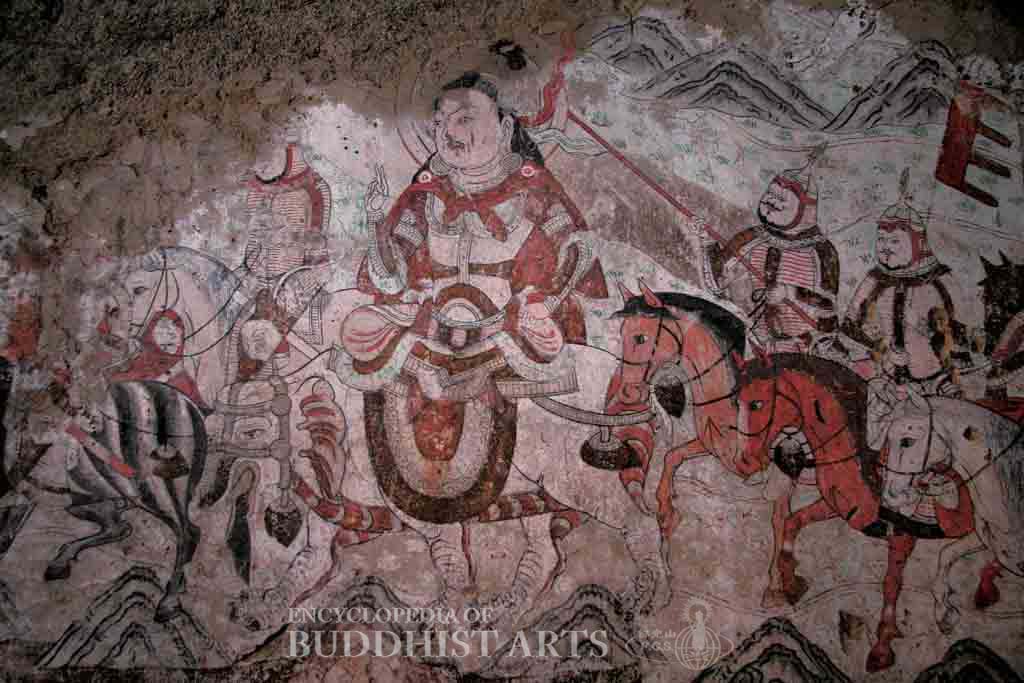
This mural depicts the seven kings leading their armies to Kushinagar. According to the Mulasarvastivada Vinaya-Vastu and the Mahaparinirvana Sutra, after the Buddha passed away into parinirvana in Kushinagar, seven nearby kingdoms requested a share of the Buddha’s relics. However, the king of Kushinagar refused, saying that the people of his kingdom had a right to all the relics since the Buddha had chosen to enter parinirvana there. Angered, the other seven kings decided to take the relics by force, gathered their armies, and advanced towards Kushinagar. However, war was averted by a brahmin named Drona who suggested to the king of Kushinagar that the relics be shared equally between the eight kingdoms. The other seven kings each took their share of the relics back to their own lands and built stupas to enshrine them.
In this mural, King Ajatasatru (reigned 491–459 BCE) is portrayed as a dignified, majestic figure riding on an elephant. He has a nimbus around his head and is dressed in armor. The details of the armor are carefully depicted: a breastplate covers his chest, a semicircular plate protects his abdomen, arm guards shield his upper and lower arms, and he wears an armored skirt, gaiters, and pointed boots. The warriors riding horses behind him hold flags or weapons and are all dressed in helmets and armor. Mountains are painted in the background.
For more details, go to the Encyclopedia of Buddhist Arts: Painting A-H, page 102.
Cite this article:
author = Hsingyun and Youheng and Youlu and Wilson, Graham and Manho and Mankuang and Huntington, Susan,
booktitle = {Encyclopedia of Buddhist Arts: Painting A-H},
pages = 102,
title = {{Beshbalik Buddhist Temple S105 Shrine: Life of the Buddha - Distribution of Relics Among the Eight Kings}},
volume = 14,
year = {2016}}