
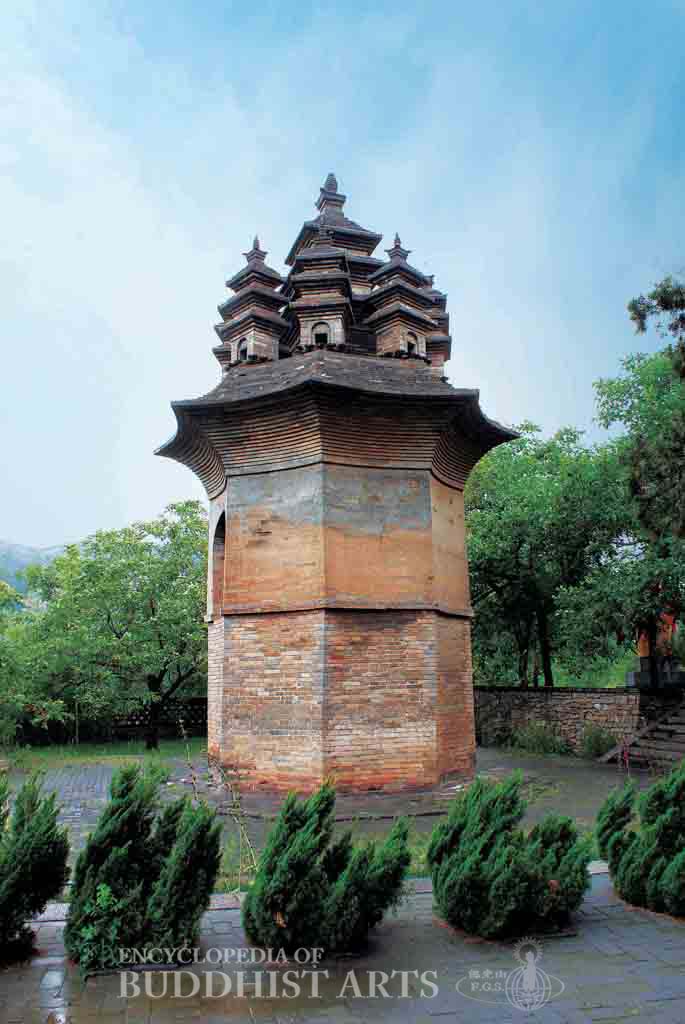
Jiuta Temple Nine Pinnacle Pagoda
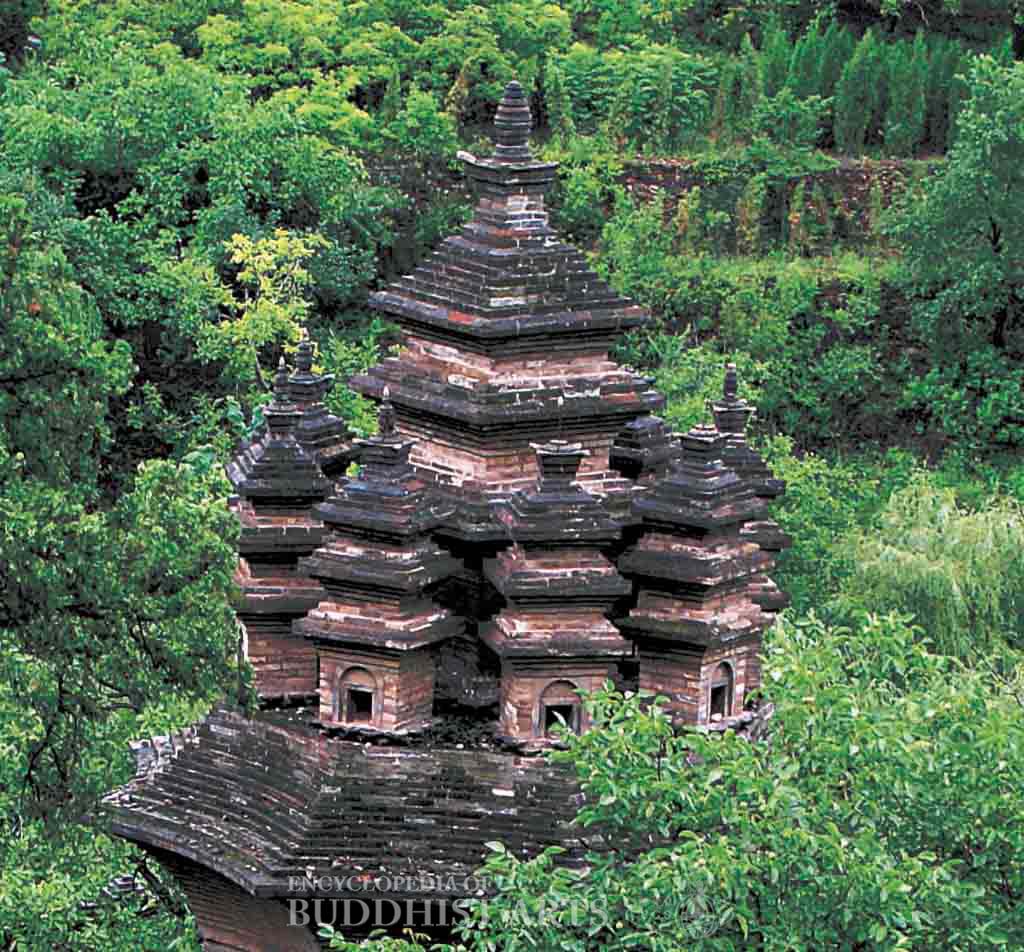
Jiuta Temple Nine Pinnacle Pagoda (aerial view)
Jiuta Temple Nine Pinnacle Pagoda
CHINA, Shandong, Jinan
The pagoda was constructed between 742 and 756 during the Tang dynasty. It was built on the grounds of Jiuta (Nine Pagoda) Temple, which no longer exists. It was listed as a National Cultural Heritage Site in 1988.
The octagonal brick pagoda is 13.3 m high and is divided into two sections: the body and spire. The body is built from small densely packed bricks and is divided into two parts. In the upper part, on the south side, there is an arched doorway leading to the central chamber, where there is a plafond and remnants of murals. The eaves are curved and consist of seventeen tiers of corbeling. The roof is formed by reverse corbeling. The upper part of the pagoda is octagonal and has a flat surface where the nine miniature pagodas are placed. The one at the center is larger than the surrounding eight pagodas. They are square and have triple eaves followed by a spire. The plain lower section of the pagoda is in stark contrast to the more complex upper section. The pagoda has a very unusual and innovative design.
For more details, go to the Encyclopedia of Buddhist Arts: Architecture G-L, page 544.
Cite this article:
author = Hsingyun and Youheng and Johnson, Peter and Mankuang and Lancaster, Lewis,
booktitle = {Encyclopedia of Buddhist Arts: Architecture G-L},
pages = 544,
title = {{Jiuta Temple Nine Pinnacle Pagoda}},
volume = 2,
year = {2016}}