
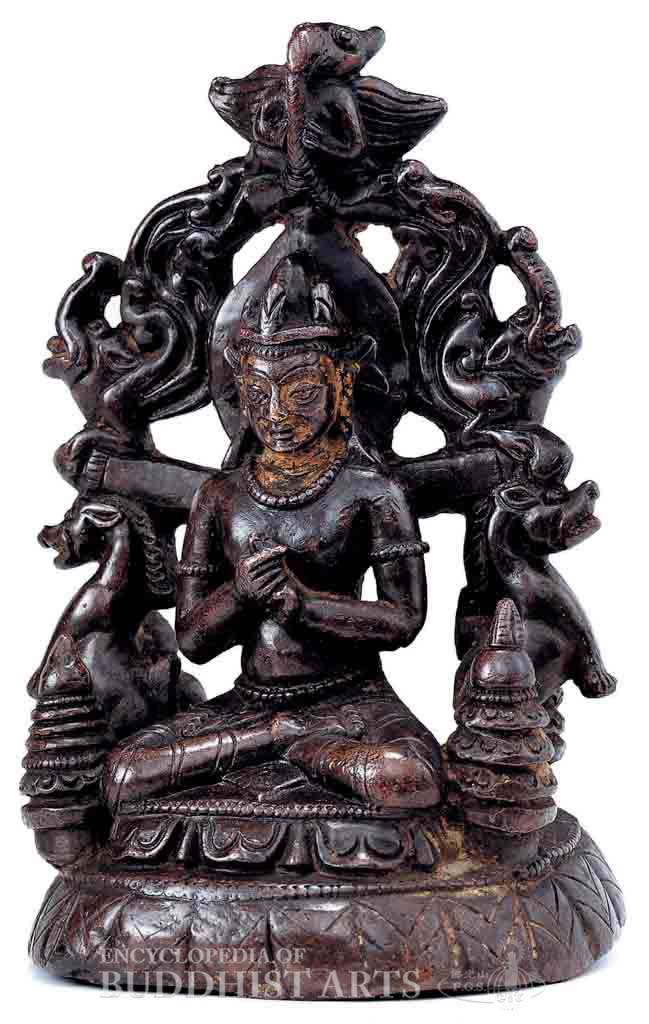
Vairocana Buddha
Bronze
Vairocana Buddha
CHINA
The Buddha is seated in the full lotus position on a lotus throne with hands in the bodhyangi (wisdom fist) mudra. The upper body is decorated sparsely with a few pieces of beaded jewelry, and a petal-shaped nimbus surrounds the head. An array of creatures piled together to form a mandorla is behind the Buddha. The animals include a garuda at the top, a pair of makaras in the center, a lion, and a goat. Rounded stupas are located on each corner of the throne, representing the Buddhas of the four directions. The statue displays characteristics popular during the Pala period (circa 8th–12th century) so scholars believe the artwork may have been brought to Tibet from India.
For more details, go to the Encyclopedia of Buddhist Arts: Sculpture St-Z, page 1284.
Cite this article:
author = Hsingyun and Youheng and Lovelock, Yann and Chou, Yuan and Huntington, Susan and Edson, Gary and Neather, Robert,
booktitle = {Encyclopedia of Buddhist Arts: Sculpture St-Z},
pages = 1284,
title = {{Vairocana Buddha}},
volume = 13,
year = {2016}}