
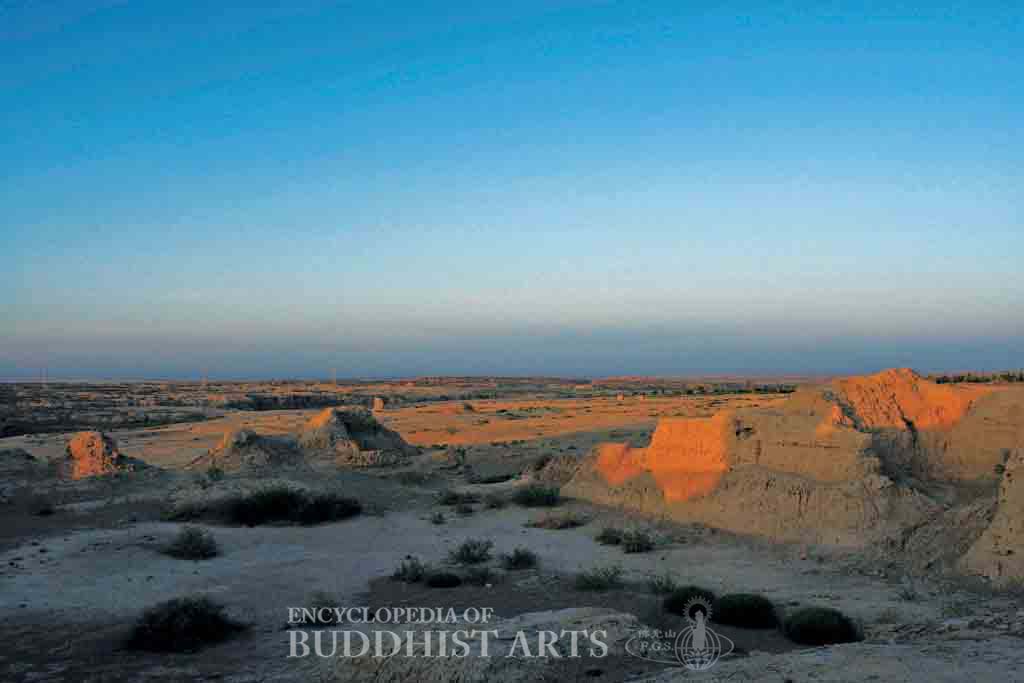
Baiyanggou
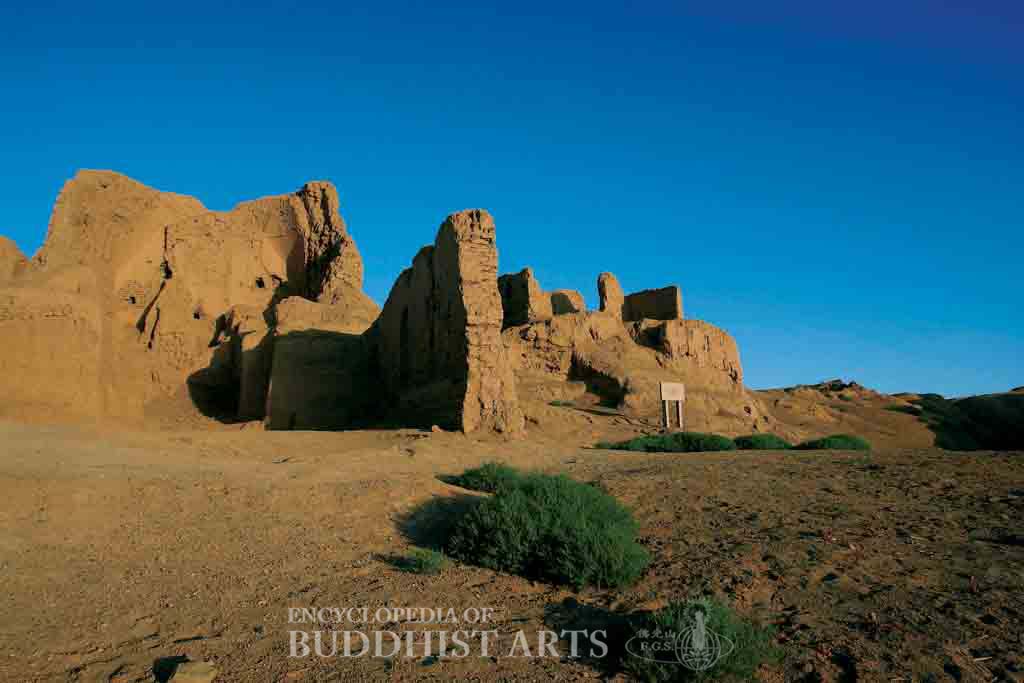
Baiyanggou
Baiyanggou
CHINA, Xinjiang, Kumul
The ruins at Baiyanggou are those of the largest and earliest Buddhist temple in Kumul. Judging from its architectural layout and the surviving murals, the temple is thought to have been built during the Tang dynasty (618–907), when Buddhism was flourishing in Xinjiang. It fell into disuse following the spread of Islam into Kumul around the 14th to 15th centuries. It was listed as a National Cultural Heritage Site in 2001.
The ruins are mainly distributed along the east and west banks of the Baiyang River. There are caves carved into cliffs as well as temples and stupas built on the ground. On the east bank there was a Buddhist temple, of which only the foundations of the walls are left. The west bank is divided into north and south areas, with 11 caves in the north and one site in the south. Some of the caves were carved directly into the cliffs, but most are formed by carving into the cliff and adding adobe walls. The latter may have been the result of past reconstruction work. The caves are either square or rectangular, and most of them have vaulted ceilings. Some of the caves contain both front and rear chambers, with traces of murals still visible.
The main building in the south of the west bank was built in adobe blocks. The building is 15 m high and has a 4.6 m long corridor that connects the front and rear chambers. The rear chamber has a barrel-vaulted ceiling and measures 8.3 m from east to west and 8.7 m from south to north. It houses a seated Buddha statue. At the south of the rear chamber, there is a small building with a barrel-vaulted ceiling. There are small niches on its left, right, and back walls, and traces of murals. A relatively well-preserved square shrine with a vaulted ceiling stands south of the main building. It contains partially damaged murals.
For more details, go to the Encyclopedia of Buddhist Arts: Architecture A-F, page 40.
Cite this article:
author = Hsingyun and Youheng and Johnson, Peter and Mankuang and Lancaster, Lewis,
booktitle = {Encyclopedia of Buddhist Arts: Architecture A-F},
pages = 40,
title = {{Baiyanggou}},
volume = 1,
year = {2016}}