
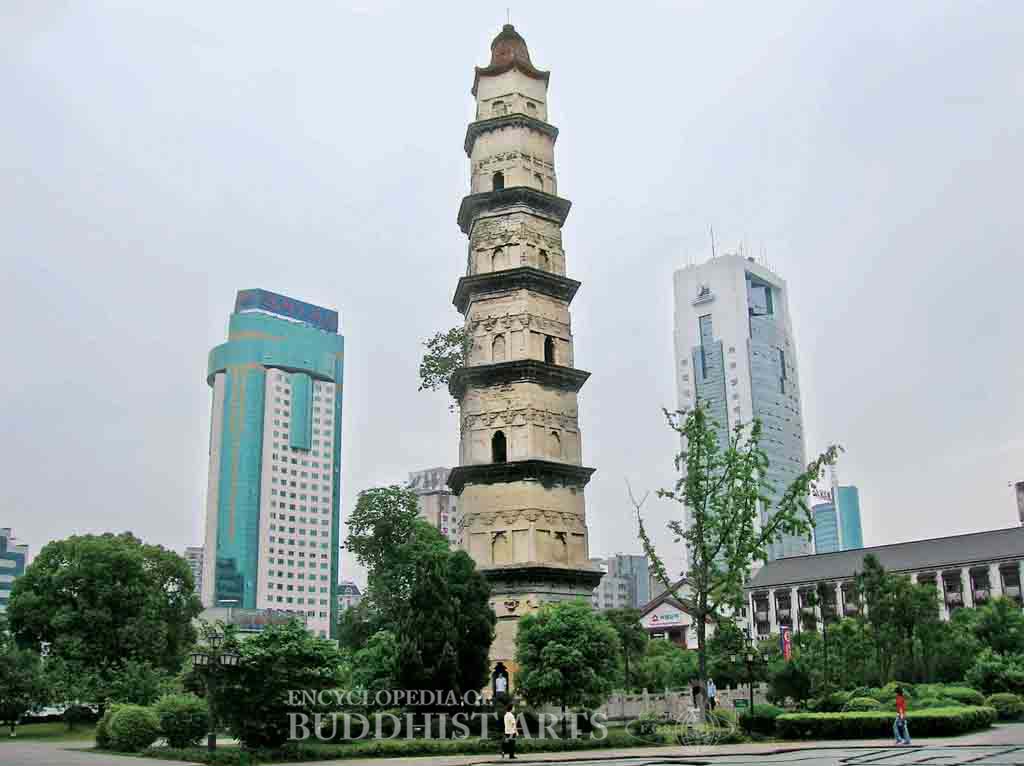
Dashan Temple Pagoda
Dashan Temple Pagoda
CHINA, Zhejiang, Shaoxing
Both the pagoda and temple were built in 504 during the Southern Liang dynasty (502–557). The temple was later destroyed leaving only the pagoda, which flourished and declined throughout its history. It was rebuilt in 1228 during the Southern Song dynasty. It was repaired in 1403 during the Ming dynasty, and again in 1669 during the Qing dynasty. Renovations were carried out in 1957 and the wooden intermediate eaves were removed.
The seven-story, hexagonal, brick and timber pagoda measures 40.5 m high. The sides on the first story are 3.8 m long with ogee arched doors on every side. From the second story upwards, there is either an ogee arched door or a false door on each side. Above the pyramidal roof there is a spire in the form of an inverted bowl made of iron. The pagoda is hollow and has a caisson ceiling. The stairs, which allowed access to the top, are no longer there.
For more details, go to the Encyclopedia of Buddhist Arts: Architecture A-F, page 213.
Cite this article:
author = Hsingyun and Youheng and Johnson, Peter and Mankuang and Lancaster, Lewis,
booktitle = {Encyclopedia of Buddhist Arts: Architecture A-F},
pages = 213,
title = {{Dashan Temple Pagoda}},
volume = 1,
year = {2016}}