
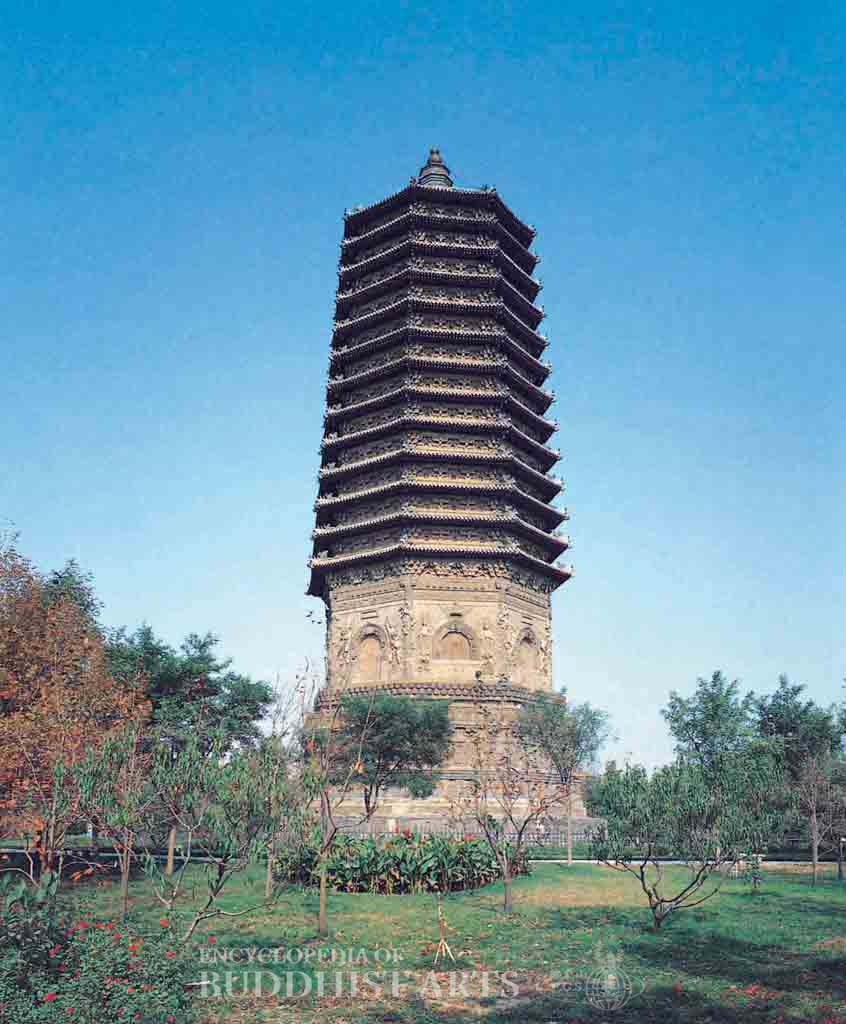
Cishou Temple Pagoda
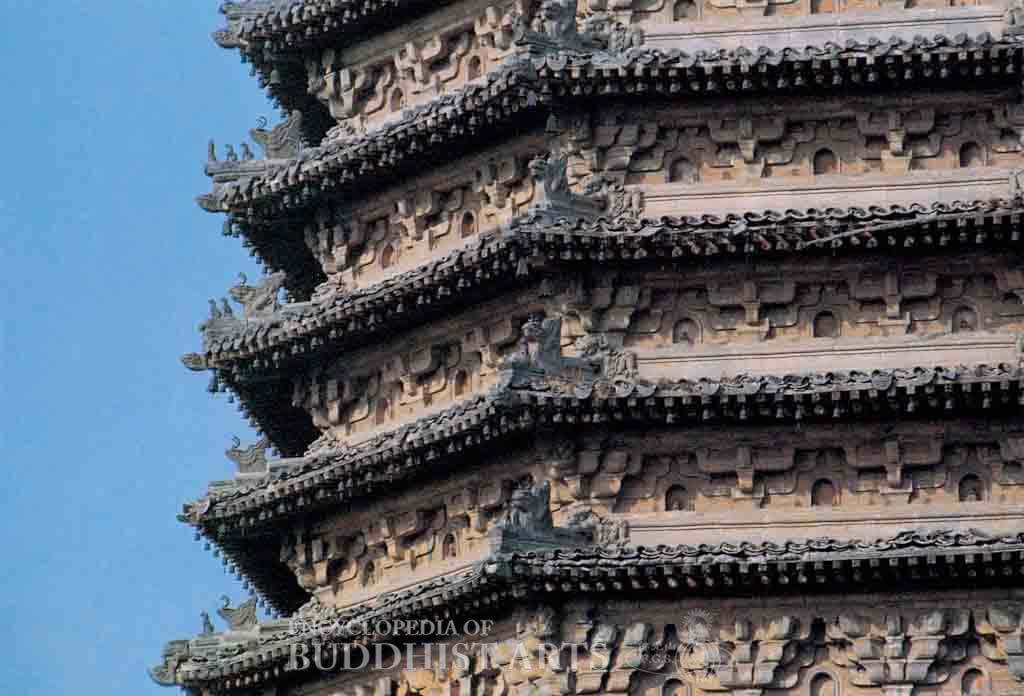
Cishou Temple Pagoda (detail)
Cishou Temple Pagoda
CHINA, Beijing
The construction of the temple and pagoda started in 1576 during the Ming dynasty, and was completed in two years. Emperor Wanli (reigned 1572–1620) built it on behalf of his mother Empress Dowager Cisheng. It was destroyed at the end of the Qing dynasty (1644–1911), with only the pagoda remaining. The pagoda was listed as a Municipal Cultural Heritage Site in 1957.
The 13-tier, octagonal, solid brick pagoda is 50 m high. It is built on a high base with a number of horizontal sections culminating in a band of dog tooth bricks. The first tier has fake arched doorways alternating with windows in a similar style. The eaves of the first tier are supported by intricately carved bracket sets, while subsequent eaves have simpler bracket sets. The ridges of the roofs have carvings of various animals. The octagonal pyramidal roof is surmounted by a spire with an octagonal base, an upturned lotus, and a gourd-shaped spire. It is constructed in a style very similar to that of the Liao dynasty (907–1125) Tianning Temple Pagoda in Beijing.
For more details, go to the Encyclopedia of Buddhist Arts: Architecture A-F, page 176.
Cite this article:
author = Hsingyun and Youheng and Johnson, Peter and Mankuang and Lancaster, Lewis,
booktitle = {Encyclopedia of Buddhist Arts: Architecture A-F},
pages = 176,
title = {{Cishou Temple Pagoda}},
volume = 1,
year = {2016}}