
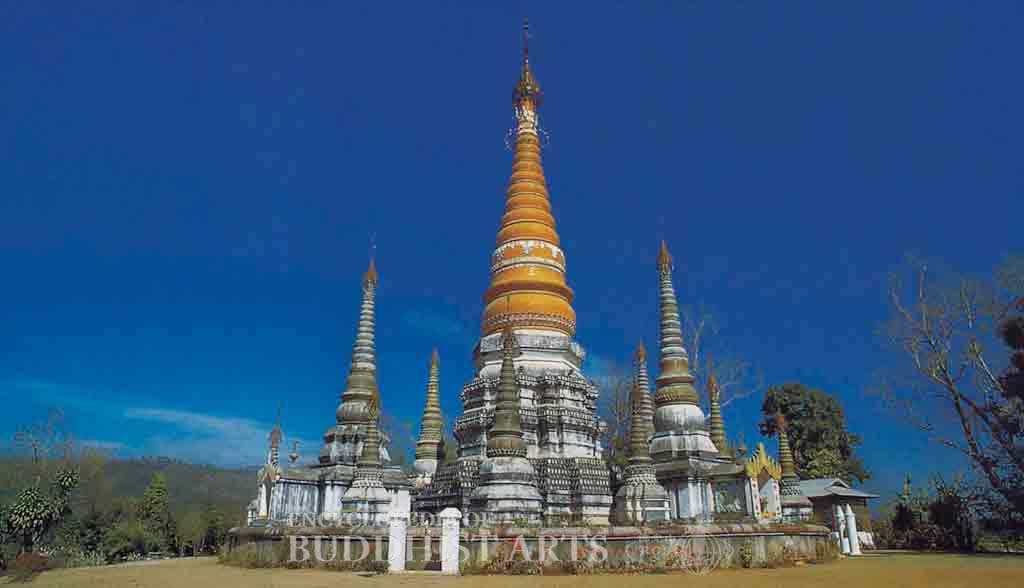
Jiele Golden Pagoda
Jiele Golden Pagoda
CHINA, Yunnan, Ruili
In the Dai language this complex is called Guangmu Hemao, which means Pagodas at the End of the Basin. The pagodas are Theravada Buddhist pagodas. The Golden Pagoda is believed to have been constructed during the reign of Zhao Wuding (reigned 762–circa 802), ruler of Mengmao (present day Ruili). It was repaired six times until the 14th century, when the Sinan ruler expanded the entire structure. The present Golden Pagoda is a reconstruction from 1980. It is listed as a Dehong Dai and Jingpo Autonomous Prefecture Cultural Heritage Site.
The complex occupies 38.5 sq m and consists of 17 pagodas: the main pagoda (known as the Golden Pagoda), eight medium-sized pagodas, and eight small pagodas. They are all constructed from brick and are solid. Each stands on a round base that measures 30 m in diameter and is 1.5 m high. The main pagoda is 36 m high and is located in the center. Surrounding it are the medium-sized pagodas, which are either 9.5 m high or 13.5 m high. The outer pagodas are 6.3 m high. On the perimeter are Buddha niches facing the four cardinal directions.
Also at the site are Buddhist halls, monastic quarters, and bamboo buildings, all built in typical Dai pile-dwelling style.
For more details, go to the Encyclopedia of Buddhist Arts: Architecture G-L, page 512.
Cite this article:
author = Hsingyun and Youheng and Johnson, Peter and Mankuang and Lancaster, Lewis,
booktitle = {Encyclopedia of Buddhist Arts: Architecture G-L},
pages = 512,
title = {{Jiele Golden Pagoda}},
volume = 2,
year = {2016}}