
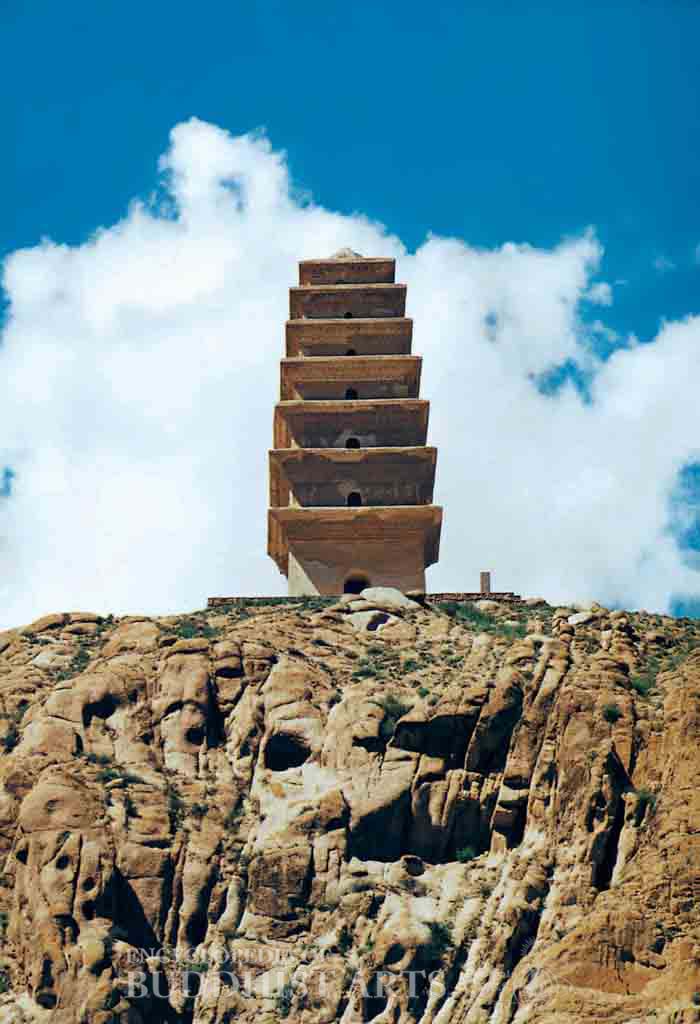
Shengrong Temple Pagodas: Big Pagoda
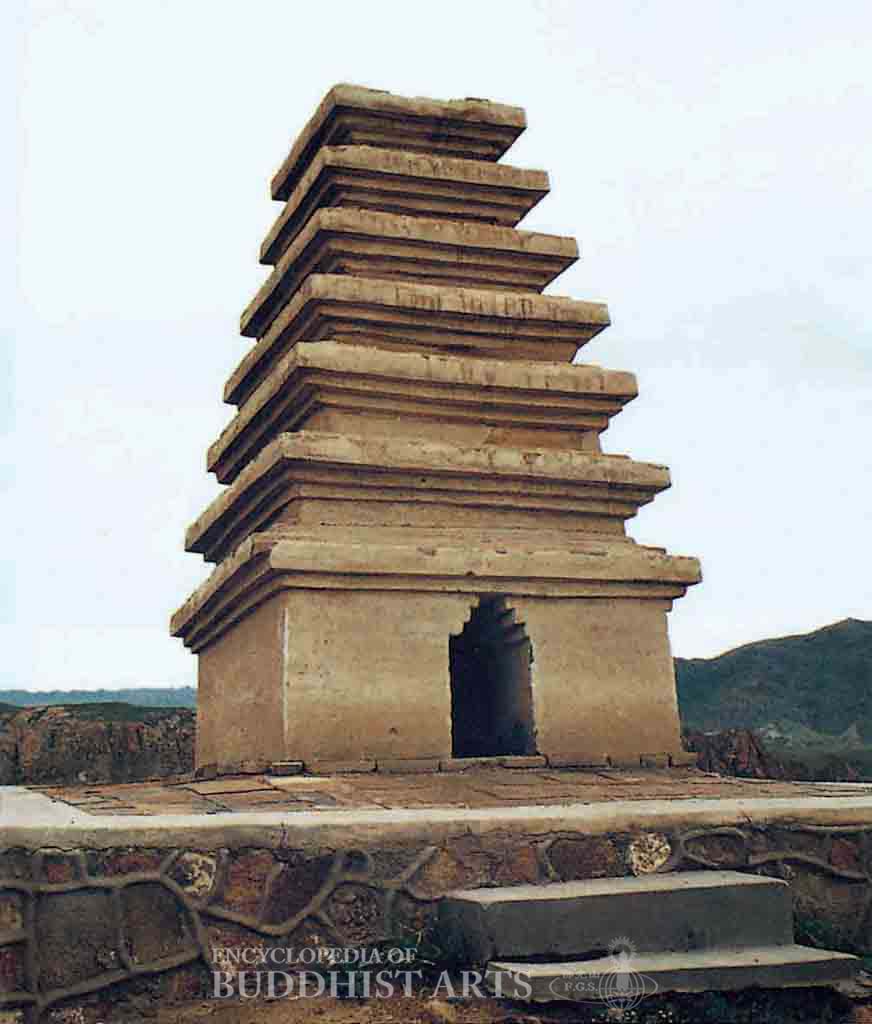
Shengrong Temple Pagodas: Small Pagoda
Shengrong Temple Pagodas
CHINA, Gansu, Jinchang
These big and small pagodas were originally part of Shengrong Temple. They are the only existing Tang dynasty (618–907) pagodas still in good condition within the province. Shengrong Temple was constructed in 561 during the Northern Zhou dynasty. The temple was demolished by local farmers in 1953 with only the pagodas still left standing. They were listed as a National Cultural Heritage Site in 2001.
Both seven-tier pagodas are constructed from brick and are hollow. The big pagoda is located on a hill situated at the back of the temple grounds. It has a height of 16.2 m with a 10.8 m square base. The eaves consist of corbeling. An arched doorway is located on the south side of the first level. Inside the pagoda, wooden stairs lead all the way to the top. Originally there were murals and some inscriptions inside, but they have since been destroyed by fire. The small pagoda stands on the opposite side of the river facing the big pagoda. It is 4.9 m high and is similar in design. Below the Big Pagoda there is a statue of the standing Buddha carved into the cliff face. The Buddha’s head is now kept at the Yongchang County Cultural Center. Experts estimate that the image was created during the Northern Zhou dynasty (557–581). There are also remains of the Six-Syllable Mantra inscribed in Tangut.
For more details, go to the Encyclopedia of Buddhist Arts: Architecture M-S, page 980.
Cite this article:
author = Hsingyun and Youheng and Johnson, Peter and Mankuang and Lancaster, Lewis,
booktitle = {Encyclopedia of Buddhist Arts: Architecture M-S},
pages = 980,
title = {{Shengrong Temple Pagodas}},
volume = 3,
year = {2016}}