
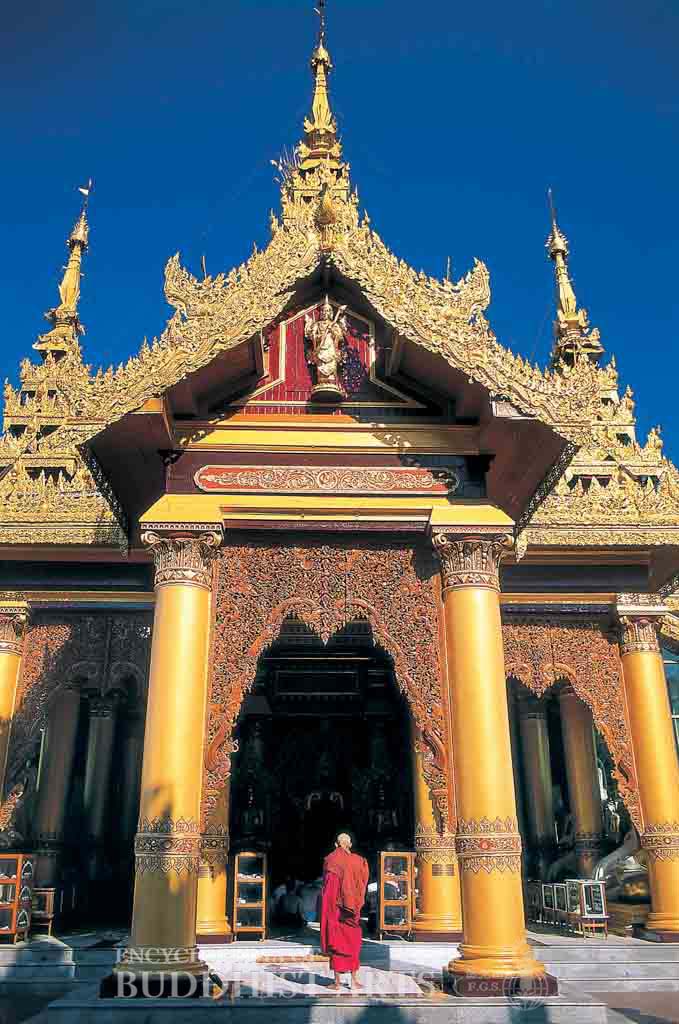
Shwedagon Pagoda: Entrance
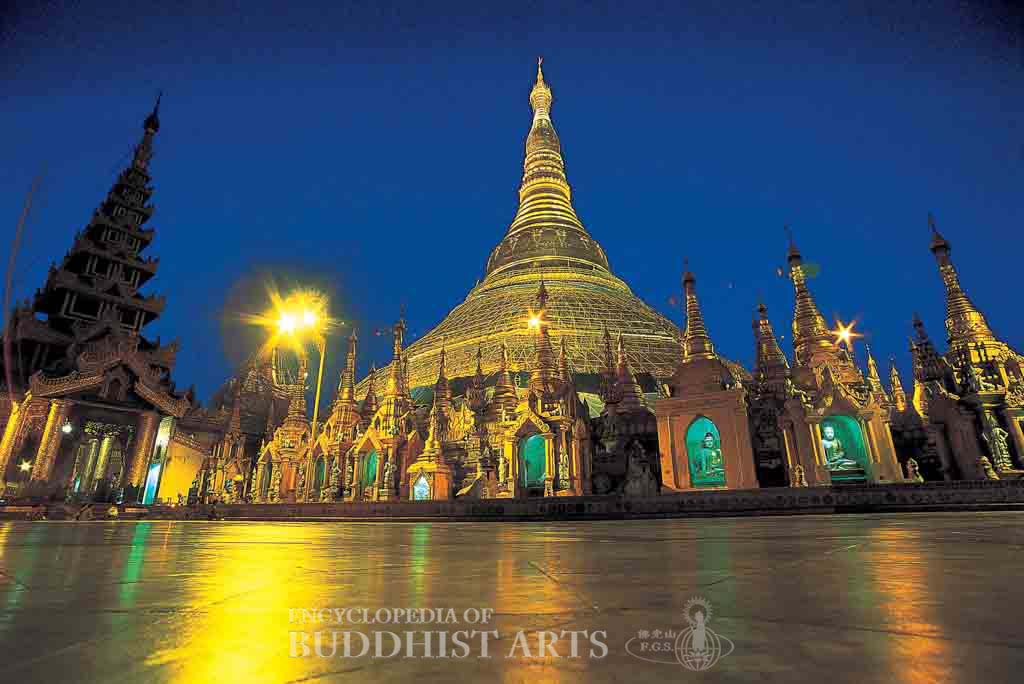
Shwedagon Pagoda
Shwedagon Pagoda
MYANMAR, Yangon
Shwedagon means Golden Pagoda. Situated on Singuttara Hill, it is the largest golden pagoda in the country. According to Buddhist history, when the merchant brothers Tapussa and Bhallika went to India, they received eight strands of the Buddha’s sacred hair after they had made offerings to him. They returned to Myanmar and offered the hair relic to the king, who then issued an edict to have a 8.2 m high pagoda built to house the relic. Subsequent kings continued to expand the pagoda and had it gilded. In 1775, King Hsinbyushin (reigned 1763–1776) of Konbaung expanded the pagoda significantly to its present size.
The 110 m high bell-shaped brick pagoda is covered with over 1,000 pieces of gold leaf. The multi-tier base is octagonal with multiple corners and has a perimeter of approximately 433 m. There is a stairway and door on each side of the base, guarded by a pair of lions. The bell-shaped body gradually narrows towards the top and becomes the spire, which is cast in pure gold and decorated with gold leaf. The canopy has over 7,000 diamonds and other jewels offered by various kings. Over 1,000 gold and 400 silver bells hang from the canopy. The finial is also studded with jewels with one very large diamond at the top. A huge jade Buddha statue is housed within the pagoda.
The main pagoda is surrounded by four medium-sized pagodas and 64 small pagodas, which form a forest of golden pagodas. In each of the medium-sized pagodas there are a gilded seated Sakyamuni Buddha statue and several hundred images of Sakyamuni Buddha in different sizes and postures. Delicately sculpted jade Buddha statues of different sizes are enshrined in the niches of the small pagodas.
For more details, go to the Encyclopedia of Buddhist Arts: Architecture M-S, page 1011.
Cite this article:
author = Hsingyun and Youheng and Johnson, Peter and Mankuang and Lancaster, Lewis,
booktitle = {Encyclopedia of Buddhist Arts: Architecture M-S},
pages = 1011,
title = {{Shwedagon Pagoda}},
volume = 3,
year = {2016}}