
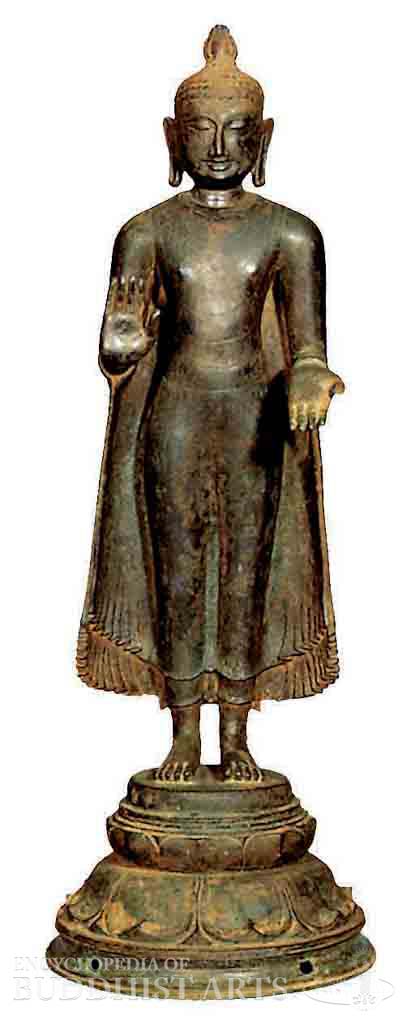
Nagapattinam: Standing Buddha
Bronze
Nagapattinam: Standing Buddha
INDIA, Tamil Nadu, Nagapattinam
The Buddha’s usnisa is flame-shaped. Both shoulders are covered by the monastic robe, the hem of which ruffles at the bottom. The right hand is lifted in abhaya (fearlessness) mudra, while the left hand is in varada (wish-granting) mudra. The figure stands on a double lotus pedestal which is wider and downturned at the base.
An inscription on the base dates the statue between 1070 and 1120 and states that it was created for religious processions. The four holes at the bottom were for inserting poles to carry the statue. Some stylistic aspects are typical of Chola art, and, in turn, these features may have influenced the art of Sri Lanka and Southeast Asia during this cosmopolitan time.
For more details, go to the Encyclopedia of Buddhist Arts: Sculpture N-Sr, page 736.
Cite this article:
author = Hsingyun and Youheng and Lovelock, Yann and Chou, Yuan and Huntington, Susan and Edson, Gary and Neather, Robert,
booktitle = {Encyclopedia of Buddhist Arts: Sculpture N-Sr},
pages = 736,
title = {{Nagapattinam: Standing Buddha}},
volume = 12,
year = {2016}}