
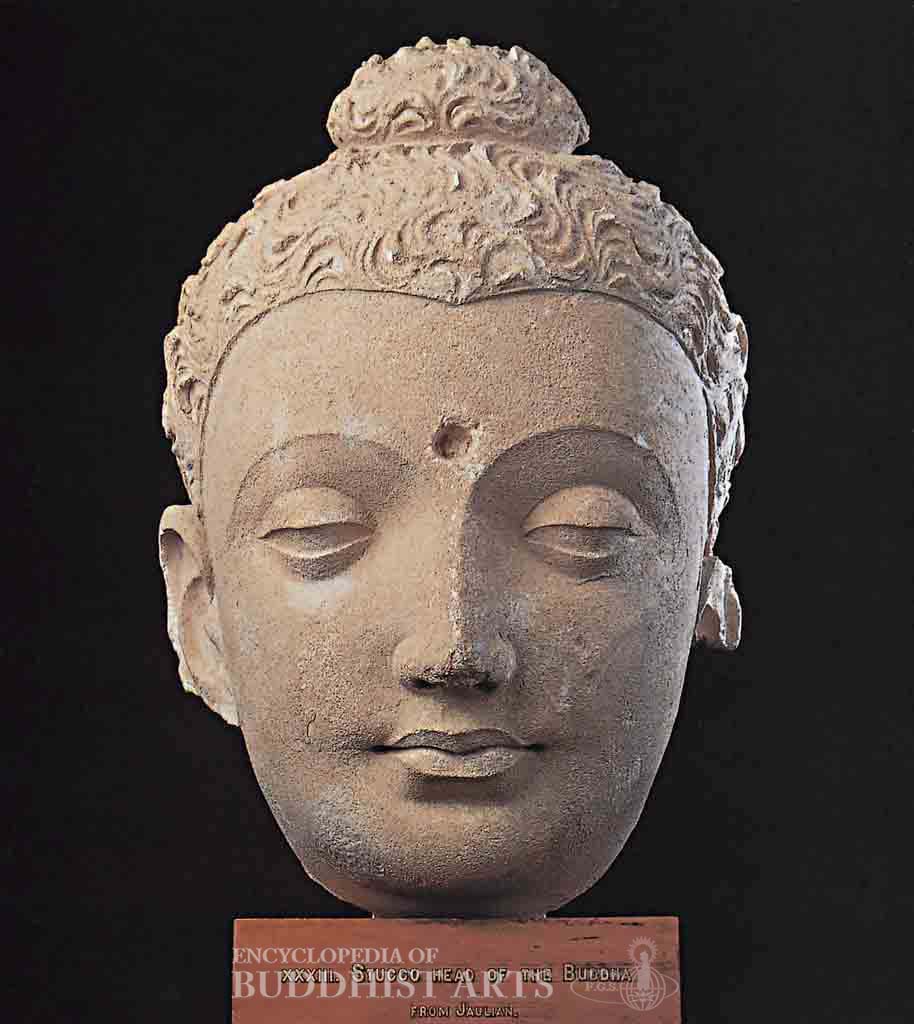
Taxila Jaulian Temple: Head of a Buddha
Stucco
Taxila Jaulian Temple: Head of a Buddha
PAKISTAN, Punjab, Taxila
The head was unearthed from the Julian Temple at Taxila. Many features of this head show the influence of the Gandharan version of the Hellenistic and Roman style, such as the wavy hair, long curved eyebrows, heavy lidded eyes and high bridged nose, made possible by the malleability of stucco. Characteristics from other contemporary cultures include the serene meditative expression made popular during the Indian Gupta period (circa 320–550), as well as such features of Buddhist iconography as the adaptation of the topknot to represent a usnisa and the presence of the urna above the eyebrows that would once have been represented by a semi-precious stone. Vestiges of paint are visible on the hair and ears.
For more details, go to the Encyclopedia of Buddhist Arts: Sculpture St-Z, page 1200.
Cite this article:
author = Hsingyun and Youheng and Lovelock, Yann and Chou, Yuan and Huntington, Susan and Edson, Gary and Neather, Robert,
booktitle = {Encyclopedia of Buddhist Arts: Sculpture St-Z},
pages = 1200,
title = {{Taxila Jaulian Temple: Head of a Buddha}},
volume = 13,
year = {2016}}