
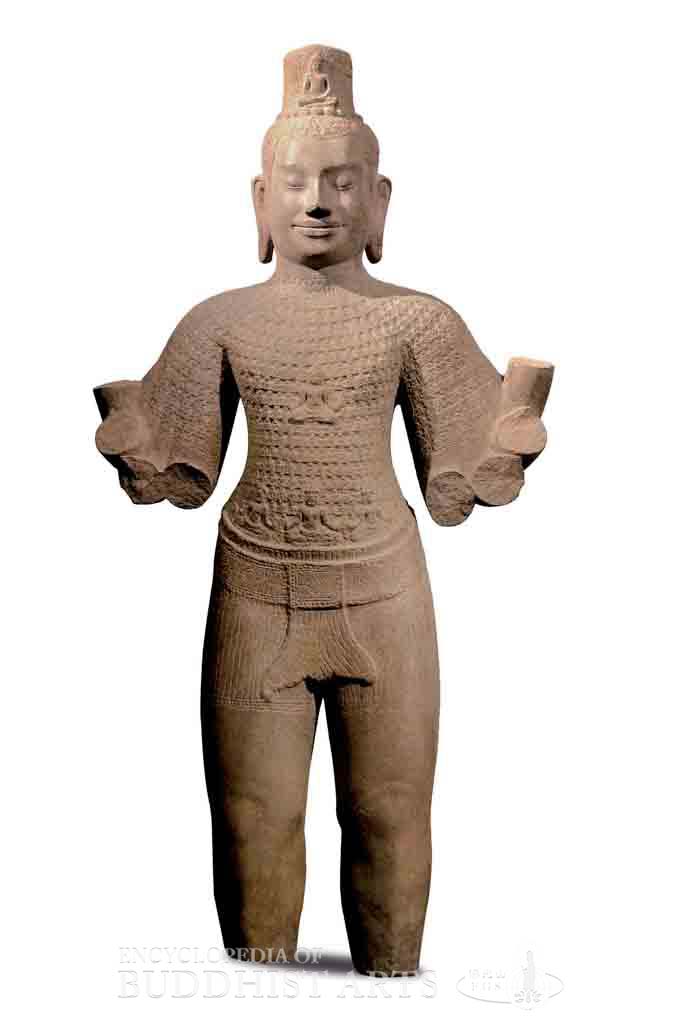
Eight-Armed Avalokitesvara
Stone
Eight-Armed Avalokitesvara
CAMBODIA
The style of this sculpture was an innovation introduced during the reign of the Buddhist monarch King Jayavarman VII (reigned 1181- circa 1220). The Bodhisattva wears a high cylindrical crown fronted by an image of Amitabha Buddha. The head is bent slightly forward and the face is rectangular. The eyes are cast down above a prominent nose and a broad, smiling mouth. There are four more Buddhas on the webbed upper body, and the webbing itself is made up of a multitude of miniature Buddhas, symbolizing the concept of the boundless Dharma within the never-ending universe. Only the stumps of the original eight arms remain, emerging from the webbing on either side as a group but held at various elevations. The short sampot is secured with a flower-patterned belt from which a fishtail of fabric hangs between the muscular legs.
For more details, go to the Encyclopedia of Buddhist Arts: Sculpture A-F, page 310.
Cite this article:
author = Hsingyun and Youheng and Lovelock, Yann and Chou, Yuan and Huntington, Susan and Edson, Gary and Neather, Robert,
booktitle = {Encyclopedia of Buddhist Arts: Sculpture A-F},
pages = 310,
title = {{Eight-Armed Avalokitesvara}},
volume = 10,
year = {2016}}