
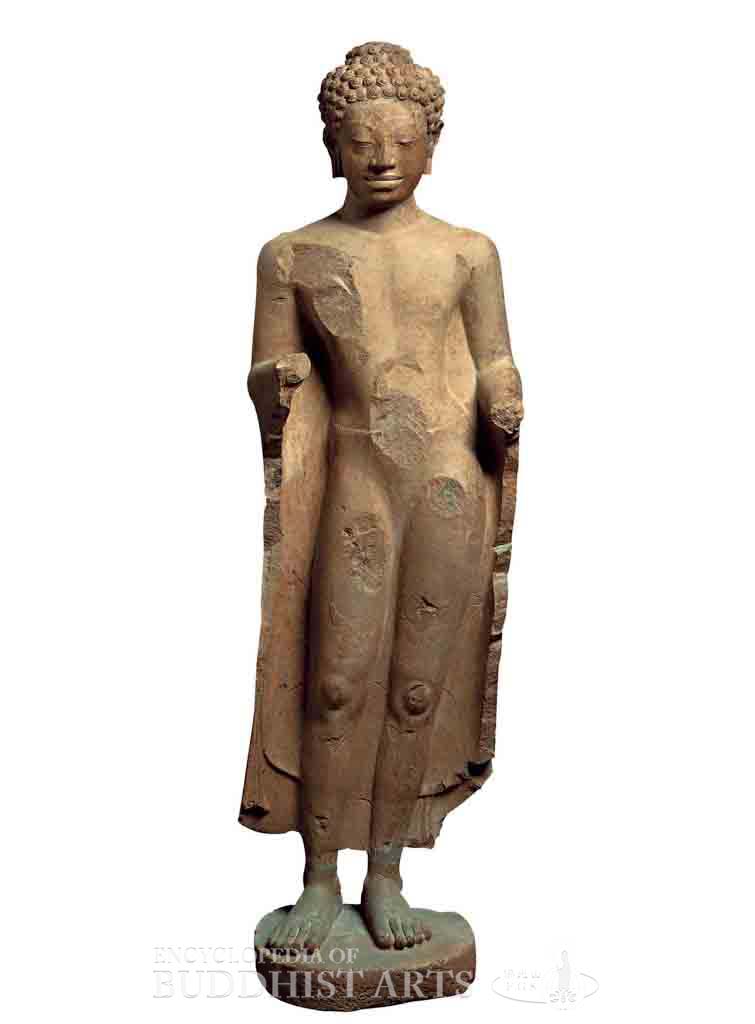
Standing Buddha
Sandstone
Standing Buddha
THAILAND; Dvaravati Kingdom
A unique feature of this Dvaravati (circa 6th–13th century) freestanding figure is the attention to anatomical detail that extends to the treatment of the Buddha’s back, where the outline of the spine is visible. Scholars believe that this feature is characteristic of Sri Thep in Phetchabun. The posture and treatment of the monastic robe are characteristic of the Indian Sarnath style from the Gupta period (circa 320–550). These elements, exclusive of the facial features that seem local, are reasons for assigning an early date to the work.
The oval face displays characteristics of the Mon people, such as the long eyes, wide nose and mouth, and thick lips. The monastic robe clings closely to the body so that the recessed areas between the shoulders, collar-bone, and chest are visible through the garment. The shape of the knees is also easily discernible. The advanced right foot displaces the waist to the right, giving the body a sinuous pose. The ruffled hem of the robe as it curves behind the calves gives the sculpture a sense of movement.
For more details, go to the Encyclopedia of Buddhist Arts: Sculpture St-Z, page 1153.
Cite this article:
author = Hsingyun and Youheng and Lovelock, Yann and Chou, Yuan and Huntington, Susan and Edson, Gary and Neather, Robert,
booktitle = {Encyclopedia of Buddhist Arts: Sculpture St-Z},
pages = 1153,
title = {{Standing Buddha}},
volume = 13,
year = {2016}}