
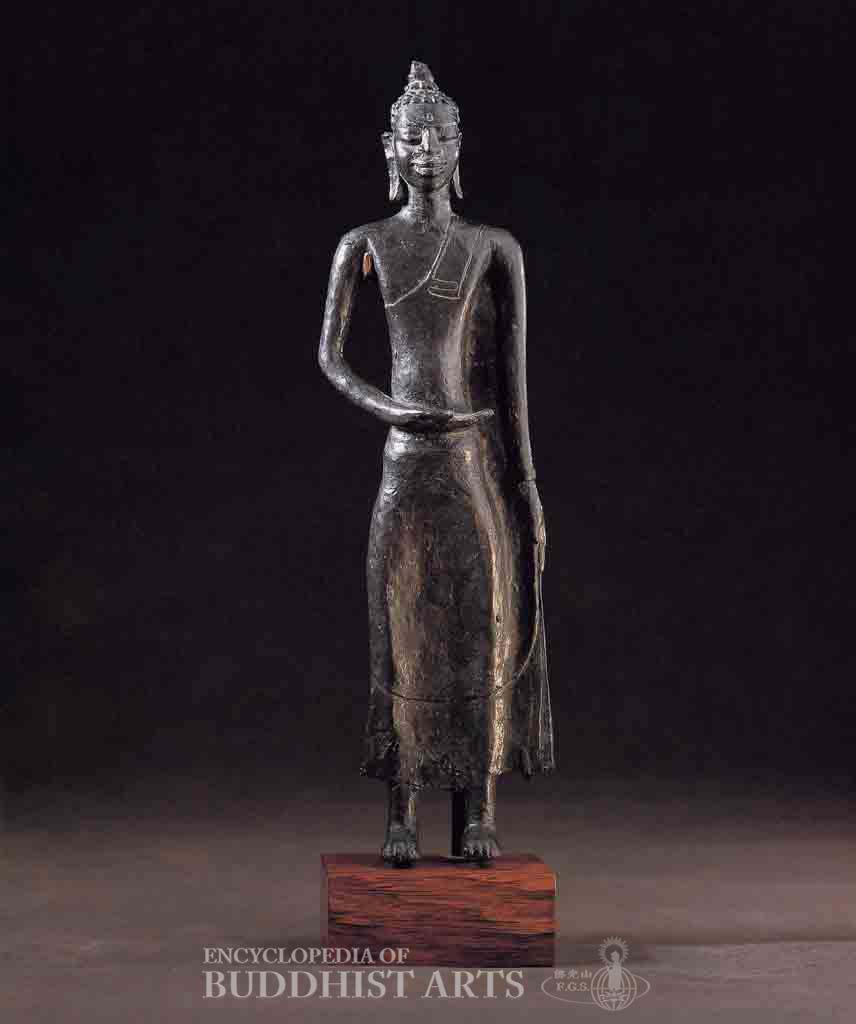
Sakyamuni Buddha
Bronze
Sakyamuni Buddha
THAILAND; Dvaravati Kingdom
This elongated sculpture dates from an earlier period of the Dvaravati Kingdom (circa 6th–13th century), when it was still under the influence of Mon culture. The sculpture is in the Nakhon Pathom style, with the Buddha’s features resembling the local people. Roughness on the back of the statue indicates that the wax model used was uneven.
The monastic robe the figure wears is simply portrayed. The right shoulder is bared and the neat fold over the left shoulder is indicated by an incision. The shoulders are broad, while the exceptionally slim waist and the accentuated upper body form an elongated triangle. The position of the right arm with the palm held upwards might suggest that the statue once held an alms bowl, although this was usually supported in both hands in later Thai statues.
For more details, go to the Encyclopedia of Buddhist Arts: Sculpture N-Sr, page 925.
Cite this article:
author = Hsingyun and Youheng and Lovelock, Yann and Chou, Yuan and Huntington, Susan and Edson, Gary and Neather, Robert,
booktitle = {Encyclopedia of Buddhist Arts: Sculpture N-Sr},
pages = 925,
title = {{Sakyamuni Buddha}},
volume = 12,
year = {2016}}