
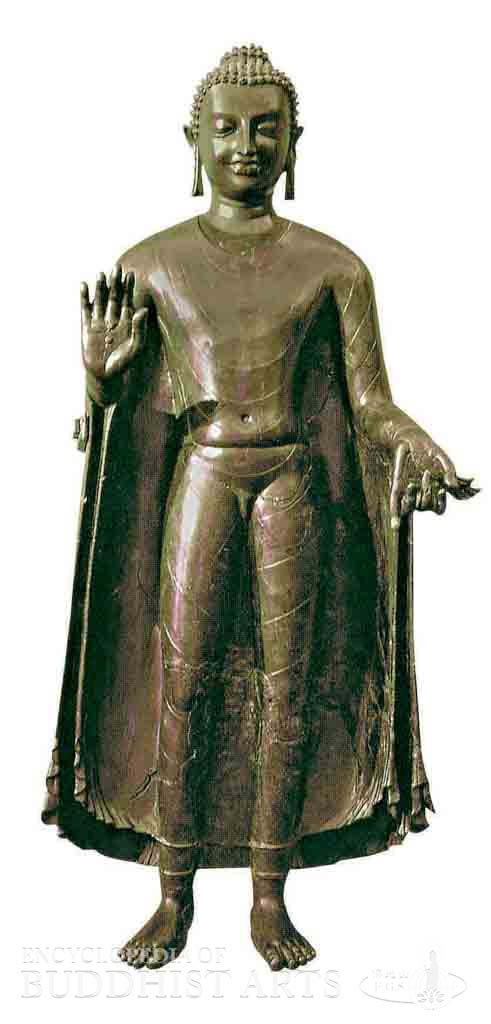
Sultanganj: Standing Buddha
Bronze
Sultanganj: Standing Buddha
INDIA, Bihar, Sultanganj
This statue is larger than life-size and weighs over 1 t. It was created using the lost-wax method and is currently the largest bronze sculpture unearthed from India. Differences in design include broader shoulders, a longer nose, and a slight widow’s peak in the ringleted hair.
The Buddha wears a diaphanous monastic robe that covers both shoulders, and folds sparsely incised across the body. The robe falls over the arms and ripple in a gentle curve behind the calves. This and the left foot slightly in advance of the lifting right foot give a sense of forward movement. The Buddha’s right hand is raised in abhaya (fearlessness) mudra, while the left hand tightens the turn of the robe about that arm.
For more details, go to the Encyclopedia of Buddhist Arts: Sculpture St-Z, page 1175.
Cite this article:
author = Hsingyun and Youheng and Lovelock, Yann and Chou, Yuan and Huntington, Susan and Edson, Gary and Neather, Robert,
booktitle = {Encyclopedia of Buddhist Arts: Sculpture St-Z},
pages = 1175,
title = {{Sultanganj: Standing Buddha}},
volume = 13,
year = {2016}}