
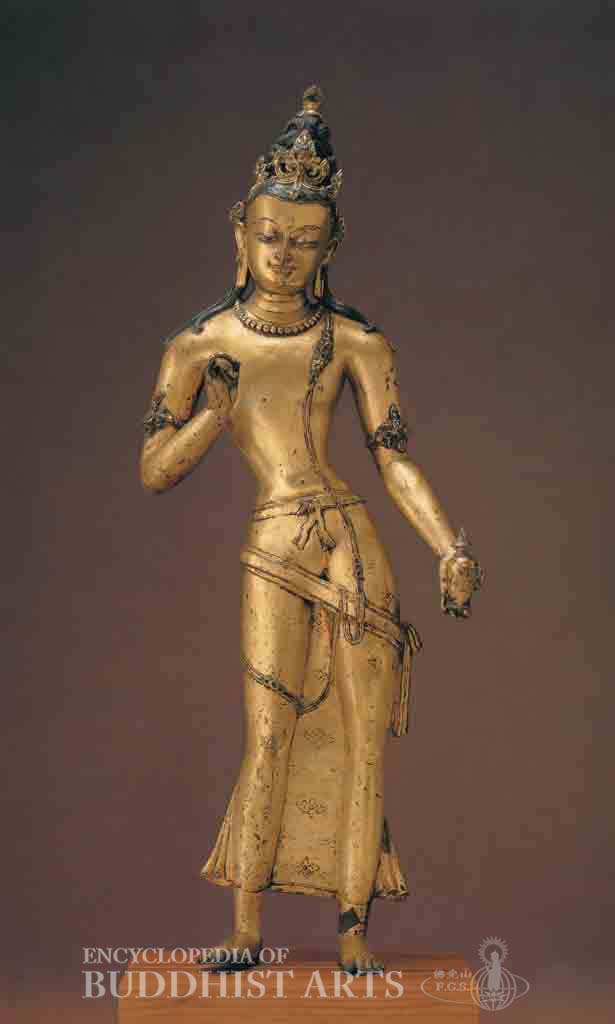
Maitreya Bodhisattva
Gilt copper
Maitreya Bodhisattva
NEPAL
Standing in the tribhanga posture, with the weight on the left foot and the sole on the right foot raised, the Bodhisattva’s exaggerated posture is unusual for early Nepalese art. The figure wears a crown and the hair is arranged in a conical topknot and topped with a flame-like finial. An urna is barely visible on the forehead but the three lines of a great person is clearly visible on the neck. There are barely any ornaments except for a beaded necklace, arm bands and a long sacred thread that falls to the thigh. A skirt decorated with floral patterns wraps about the legs. It is secured by a waistband and there is also a sash that hangs low and diagonally across the thighs. The left hand holds a vase while the right is in a mudra. The sculpture has been influenced by the Nalanda style and indicates the close relationship between Nepal and the Pala Empire (circa 8th–12th century).
For more details, go to the Encyclopedia of Buddhist Arts: Sculpture G-M, page 662.
Cite this article:
author = Hsingyun and Youheng and Lovelock, Yann and Chou, Yuan and Huntington, Susan and Edson, Gary and Neather, Robert,
booktitle = {Encyclopedia of Buddhist Arts: Sculpture G-M},
pages = 662,
title = {{Maitreya Bodhisattva}},
volume = 11,
year = {2016}}