
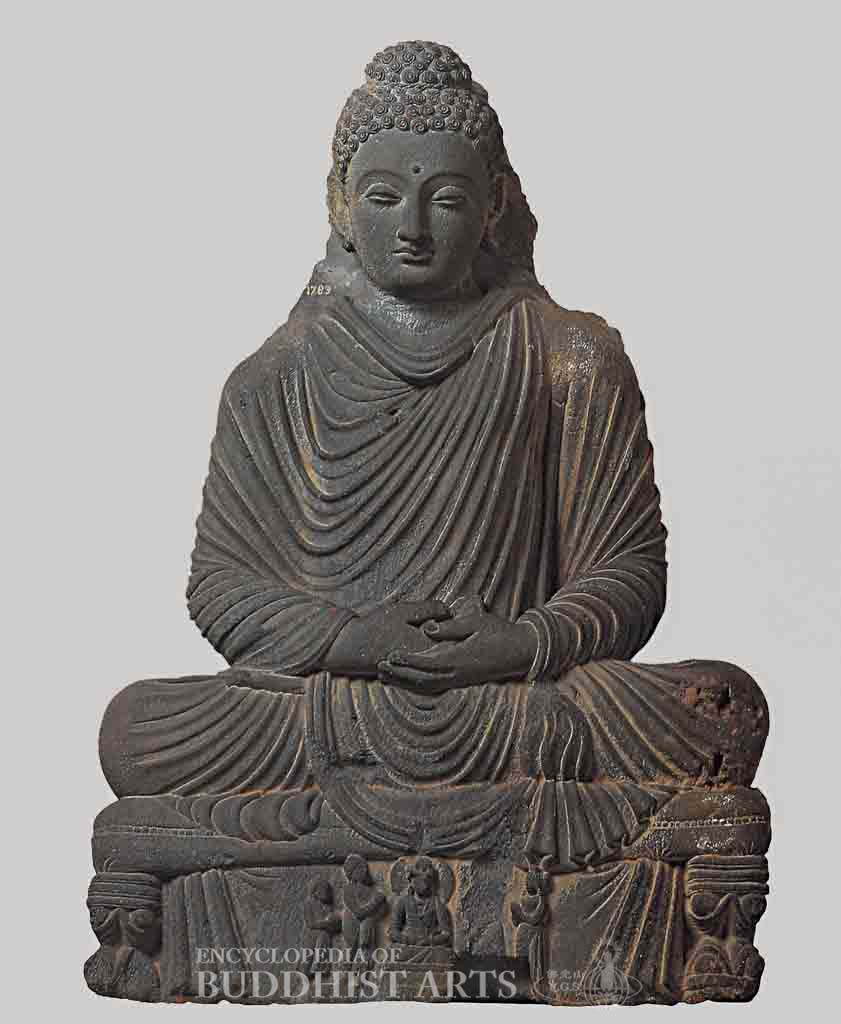
Sahri Bahlol: Seated Buddha
Schist
Sahri Bahlol: Seated Buddha
PAKISTAN, Khyber Pakhtunkhwa, Peshawar
This statue, when compared with others from the Gandhara area, is not as robust but research has revealed that the statue’s design has significantly influenced cultures further East in their portrayal of the Buddha. The most obvious influence can be seen in the highly rounded garment folds of statues from Japan’s Heian period (794–1185).
The figure wears a monastic robe that covers both shoulders and sits cross-legged with hands in dhyana (meditation) mudra. The usnisa and the presence of the urna between the brows are the most common features of the Thirty-Two Marks of Excellence found on the Buddha. Most Gandharan sculptures are influenced by the Hellenistic and Roman styles and are depicted with wavy hair, making this sculpture a rarity with the densely curled hair. The folds of the clothing are especially detailed, while the section which drapes over the cushioned throne provides an aesthetic contrast. Four figures are between the throne’s carved legs. This most likely portrays an enlightenment scene with devotees paying reverence.
For more details, go to the Encyclopedia of Buddhist Arts: Sculpture N-Sr, page 894.
Cite this article:
author = Hsingyun and Youheng and Lovelock, Yann and Chou, Yuan and Huntington, Susan and Edson, Gary and Neather, Robert,
booktitle = {Encyclopedia of Buddhist Arts: Sculpture N-Sr},
pages = 894,
title = {{Sahri Bahlol: Seated Buddha}},
volume = 12,
year = {2016}}