

Emeishan Fuhu Temple: Main Temple Gate
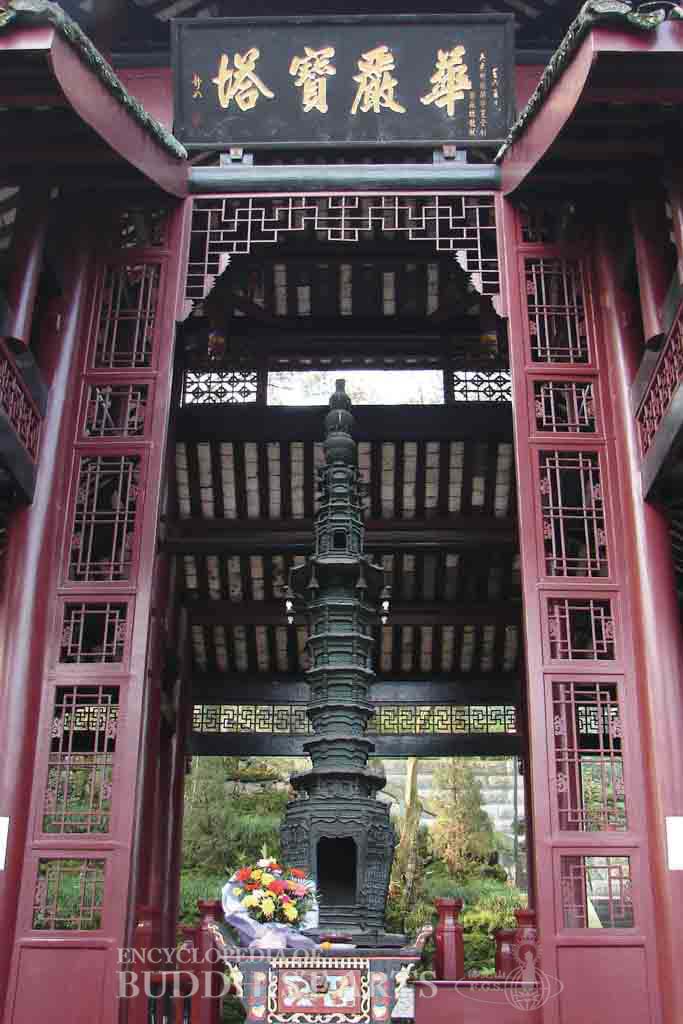
Emeishan Fuhu Temple: Avatamsaka Pagoda
Emeishan Fuhu Temple
CHINA, Sichuan, Leshan
Fuhu means Crouching Tiger. The temple is situated at the foot of Emeishan (Fine Eyebrow Mountain). It was built during the Tang dynasty (618–907). It was destroyed during the late Ming dynasty (1368–1644) and was repaired in 1651 during the Qing dynasty. There are two theories regarding its name: because tigers terrorized the area, the monks built a sutra pillar carved with the Usnisavijaya Dharani Sutra to protect the temple; the shape of the mountain resembles a crouching tiger.
The principal buildings include the main temple gate, Maitreya Hall, Bodhi Hall, Great Hero Hall, Hall of the Five Hundred Arhats, Imperial Writing Building, and the Avatamsaka Pagoda. The three bay main temple gate has eaves which turn up at the corners. As part of Emeishan, it was listed as a UNESCO World Heritage Site in 1996.
The Avatamsaka Pagoda is the largest bronze pagoda in Sichuan. It was either cast by Wan Huaxuan during the Yuan dynasty (1271–1368), or in 1585 during the Ming dynasty. It gets its name from the Avatamsaka Sutra cast on the pagoda body. It was originally located in Shengji Temple but, after the temple was destroyed, it was relocated to Baoguo Temple and then moved to this temple in 1982. The pagoda was cast in copper and is 5.8 m high. The base is hollow and has an arched doorway. The rest of the pagoda has a lower section and an upper section separated by large eaves. The spire consists of three jewels. More than 4,700 delicately cast Buddha images can be found on the pagoda.
For more details, go to the Encyclopedia of Buddhist Arts: Architecture A-F, page 268.
Cite this article:
author = Hsingyun and Youheng and Johnson, Peter and Mankuang and Lancaster, Lewis,
booktitle = {Encyclopedia of Buddhist Arts: Architecture A-F},
pages = 268,
title = {{Emeishan Fuhu Temple}},
volume = 1,
year = {2016}}