
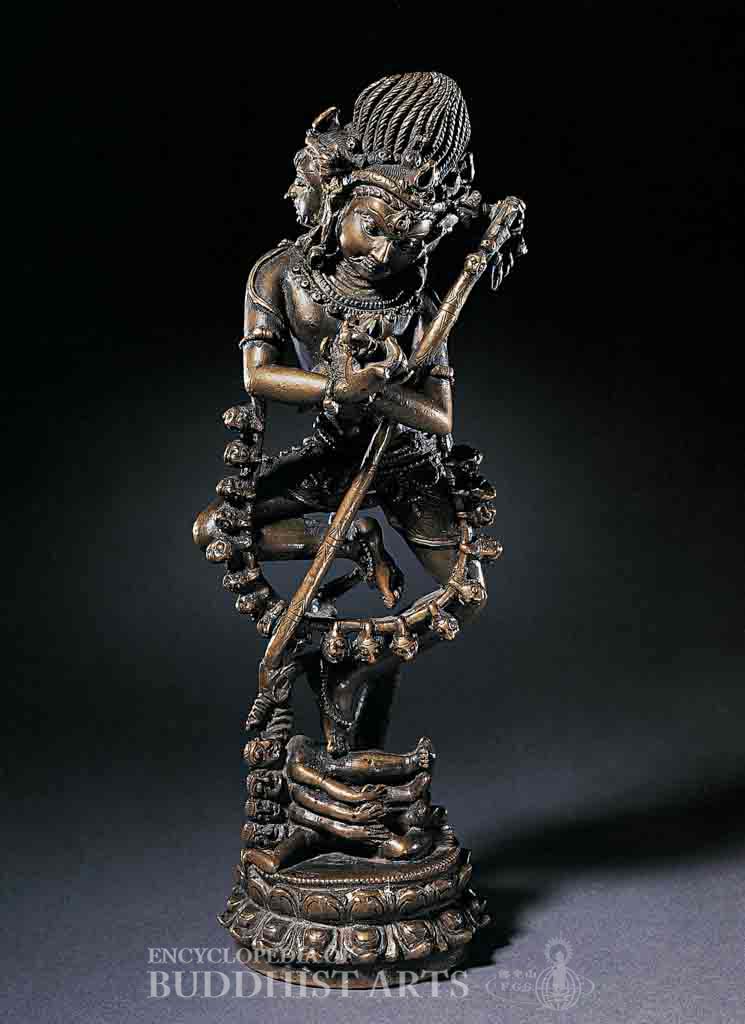
Hevajra
Gilt copper alloy
Hevajra
CHINA
Hevajra, one of the main deities of Vajrayana Buddhism, is often illustrated in a wrathful pose. This figure has three faces, a prominent third eye and protruding fangs. The braided hair is piled up into a domed structure and there is a five-skull crown above each brow. The upper body is decorated with jewels and a garland of skulls. The garland swings as the figure dances on the piled bodies of the sons of Mara, each symbolizing a mental hindrance to wisdom. Hevajra’s hands form the vajrahumkara (embracing wisdom) mudra and a tantric staff is cradled in the crook of the arms. The vajra in the figure’s left hand symbolizes compassion and the bell in the right hand symbolizes wisdom. The statue shows Indian influence but the crown and material used lead experts to believe it was made in Tibet.
For more details, go to the Encyclopedia of Buddhist Arts: Sculpture G-M, page 429.
Cite this article:
author = Hsingyun and Youheng and Lovelock, Yann and Chou, Yuan and Huntington, Susan and Edson, Gary and Neather, Robert,
booktitle = {Encyclopedia of Buddhist Arts: Sculpture G-M},
pages = 429,
title = {{Hevajra}},
volume = 11,
year = {2016}}