
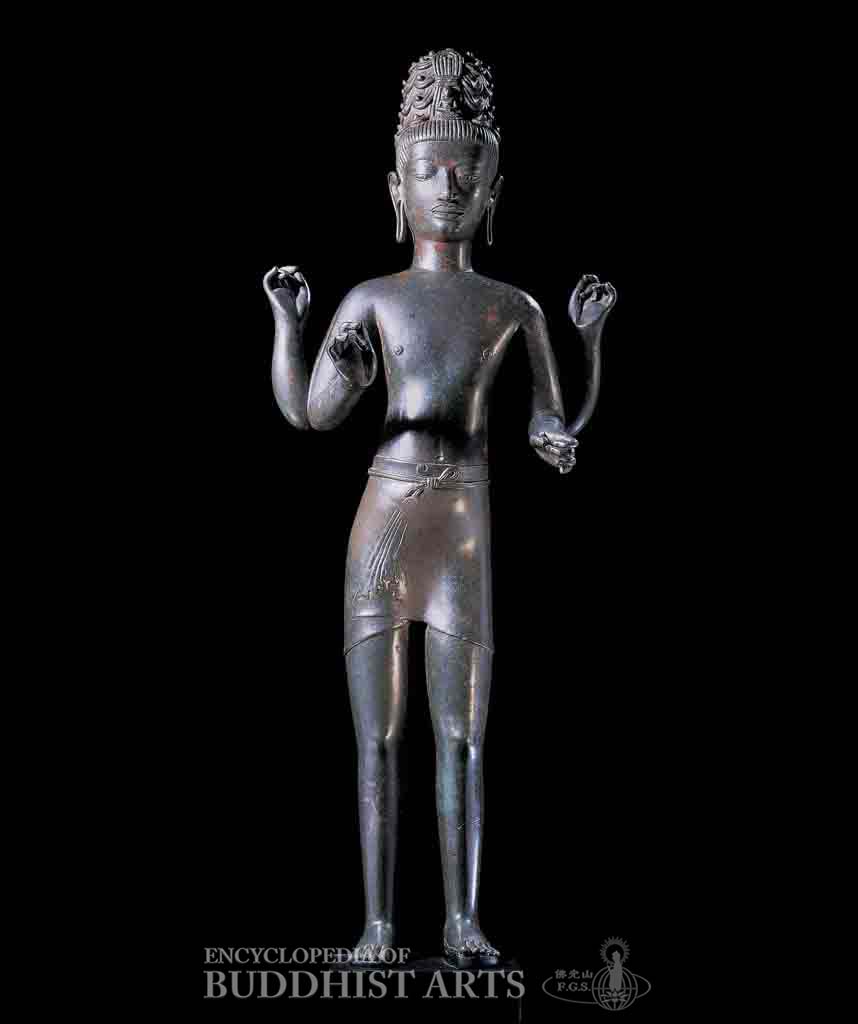
Prakhon Chai: Four-Armed Avalokitesvara
Bronze
Prakhon Chai: Four-Armed Avalokitesvara
THAILAND, Buriram, Prakhon Chai
This statue was among 40 that were excavated in 1964. It is one of the largest discovered and so well preserved that even the fingers and toes are completely undamaged. A small image of Amitabha Buddha fronting the headdress identifies the figure as Avalokitesvara. The Bodhisattva has a slender body and narrow hips tilted slightly to the left. The long expressive fingers of the four hands each form mudras. It is conjectured, however, that the hands once held the Bodhisattva’s attributes: a sutra, a lotus, prayer beads, and a vase. The lower body is wrapped with a short skirt which is secured with a central knot.
For more details, go to the Encyclopedia of Buddhist Arts: Sculpture N-Sr, page 834.
Cite this article:
Hsingyun, et al. "Prakhon Chai: Four-Armed Avalokitesvara." Encyclopedia of Buddhist Arts: Sculpture N-Sr, vol. 12, 2016, pp. 834.
Hsingyun, Youheng, Yann Lovelock, Yuan Chou, Susan Huntington, Gary Edson, and Robert Neather. 2016. "Prakhon Chai: Four-Armed Avalokitesvara" In Encyclopedia of Buddhist Arts: Sculpture N-Sr, 12:834.
Hsingyun, Youheng, Lovelock, Y., Chou, Y., Huntington, S., Edson, G., & Neather, R.. (2016). Prakhon Chai: Four-Armed Avalokitesvara. In Encyclopedia of Buddhist Arts: Sculpture N-Sr (Vol. 12, pp. 834).
@misc{Hsingyun2016,
author = Hsingyun and Youheng and Lovelock, Yann and Chou, Yuan and Huntington, Susan and Edson, Gary and Neather, Robert,
booktitle = {Encyclopedia of Buddhist Arts: Sculpture N-Sr},
pages = 834,
title = {{Prakhon Chai: Four-Armed Avalokitesvara}},
volume = 12,
year = {2016}}
author = Hsingyun and Youheng and Lovelock, Yann and Chou, Yuan and Huntington, Susan and Edson, Gary and Neather, Robert,
booktitle = {Encyclopedia of Buddhist Arts: Sculpture N-Sr},
pages = 834,
title = {{Prakhon Chai: Four-Armed Avalokitesvara}},
volume = 12,
year = {2016}}