
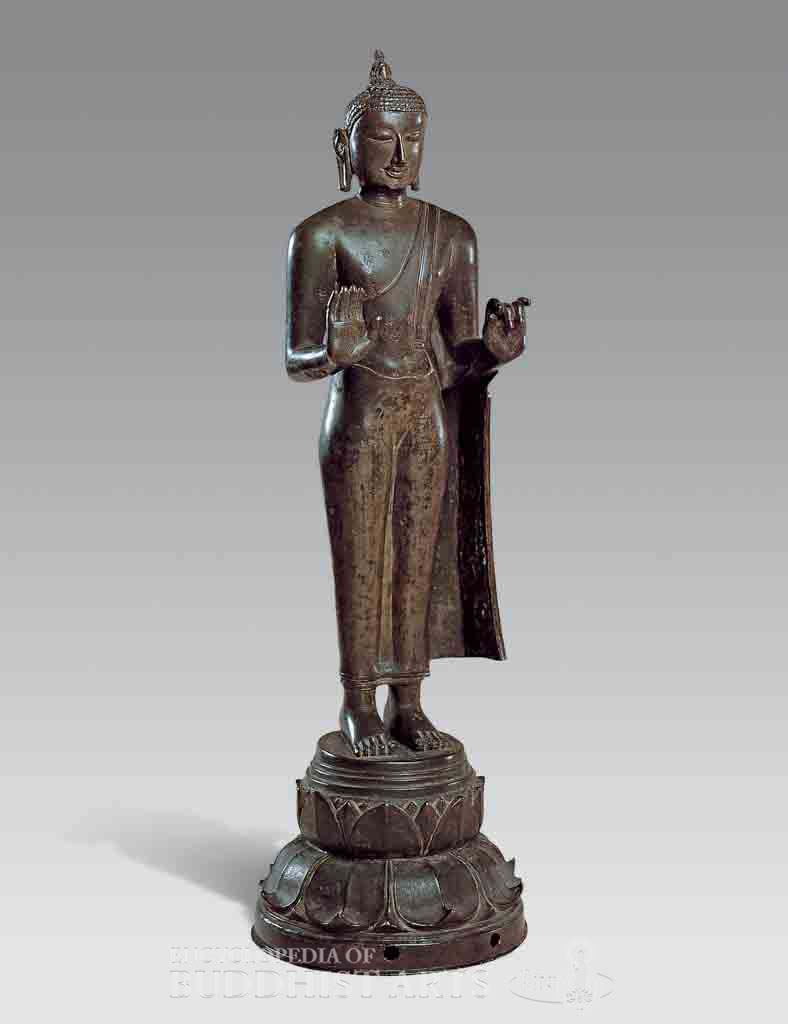
Nagapattinam: Standing Buddha
Bronze
Nagapattinam: Standing Buddha
INDIA, Tamil Nadu, Nagapattinam
The building in which this figure was discovered has been given the name “the Chinese stupa” for the reason that an inscription there states it was constructed by Chinese merchants under imperial order during the reign of King Narasimhavarman II (reigned circa 690–720). The stupa was also noted by Marco Polo during his visit to India.
The Buddha’s usnisa is shaped in a lotus bud design. The line of the nose is pronounced, the long earlobes are hollowed and the neck has the three lines of a great person. The thin monastic robe leaves the right shoulder bare and allows the shape of the legs to show through. The right arm is raised in abhaya (fearlessness) mudra and the left in karana (warding off evil) mudra. The double lotus pedestal on which the figure stands is wider at the bottom, with the lower row downturned.
For more details, go to the Encyclopedia of Buddhist Arts: Sculpture N-Sr, page 736.
Cite this article:
author = Hsingyun and Youheng and Lovelock, Yann and Chou, Yuan and Huntington, Susan and Edson, Gary and Neather, Robert,
booktitle = {Encyclopedia of Buddhist Arts: Sculpture N-Sr},
pages = 736,
title = {{Nagapattinam: Standing Buddha}},
volume = 12,
year = {2016}}