
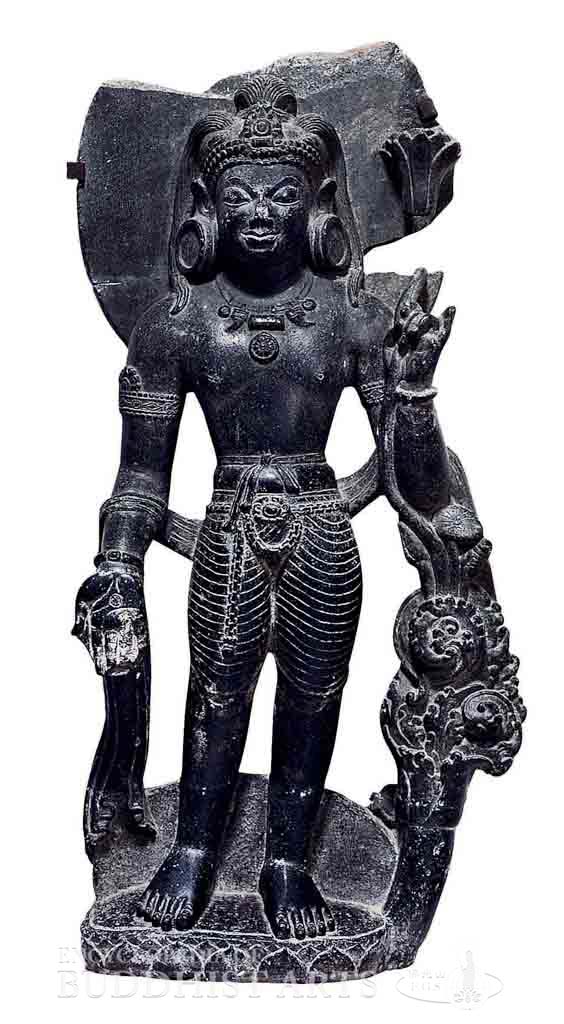
Nalanda: Manjusri Bodhisattva
Stone
Nalanda: Manjusri Bodhisattva
INDIA, Bihar
The sculpture is identified as an earlier artwork from the Pala period (circa 8th–12th century) by reason of its slender figure and restrained style, in contrast to the later robust and exuberant depictions.
Manjusri Bodhisattva has a wide nose and a thick lower lip. His hair is tied into three locks that overhang the coronet. He wears large ear ornaments and a necklace with a Dharma wheel and the tiger claws that symbolize his youthfulness. A knotted band encircles the waist, below which an ornamented belt secures the short skirt with stylized folds. The right hand makes the varada (wish-granting) mudra, exposing a Dharma wheel on the palm. The forearm is encircled by a stole that winds from behind the body to the ground. The left hand holds the stem of a lotus that blooms at the edge of the broken nimbus. The lotus grows upwards from a flowering outgrowth of the pedestal on which the figure stands, thus creating a circular rhythm completed by the fall of the stole on the other side.
For more details, go to the Encyclopedia of Buddhist Arts: Sculpture N-Sr, page 751.
Cite this article:
author = Hsingyun and Youheng and Lovelock, Yann and Chou, Yuan and Huntington, Susan and Edson, Gary and Neather, Robert,
booktitle = {Encyclopedia of Buddhist Arts: Sculpture N-Sr},
pages = 751,
title = {{Nalanda: Manjusri Bodhisattva}},
volume = 12,
year = {2016}}