
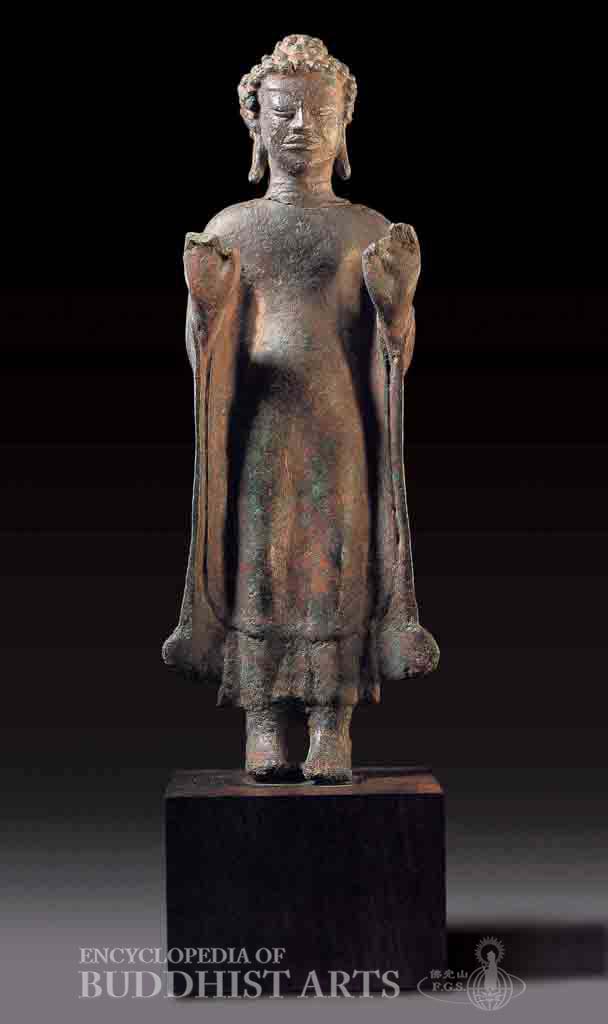
Sakyamuni Buddha
Bronze
Sakyamuni Buddha
THAILAND; Dvaravati Kingdom
The statue is believed to date to early 8th century of the Dvaravati Kingdom (circa 6th–13th century), although the facial features are somewhat different from statues of that era and the workmanship is rather rough. Corrosion on the surface reveals that the statue was once buried for a long time, which explains the repairs done to the broken neck. The work is most likely from Nakhom Pathom or U Thong, both in what is now central Thailand.
The Buddha’s exaggerated and unevenly curled hair overhangs the top of the ears. The wide mouth and full lips are typical of Mon workmanship. The figure wears a thin monastic robe that covers both shoulders and reveals the outline of the figure. The hands are raised but the damage is too great to accurately identify a mudra. The hem of the robe drapes down the body. The Buddha’s left leg is positioned slightly forward, giving the statue a sense of movement.
For more details, go to the Encyclopedia of Buddhist Arts: Sculpture N-Sr, page 926.
Cite this article:
author = Hsingyun and Youheng and Lovelock, Yann and Chou, Yuan and Huntington, Susan and Edson, Gary and Neather, Robert,
booktitle = {Encyclopedia of Buddhist Arts: Sculpture N-Sr},
pages = 926,
title = {{Sakyamuni Buddha}},
volume = 12,
year = {2016}}