
Wutaishan Shiziwo Liuli Pagoda
Wutaishan Shiziwo Liuli Pagoda
CHINA, Shanxi, Xinzhou
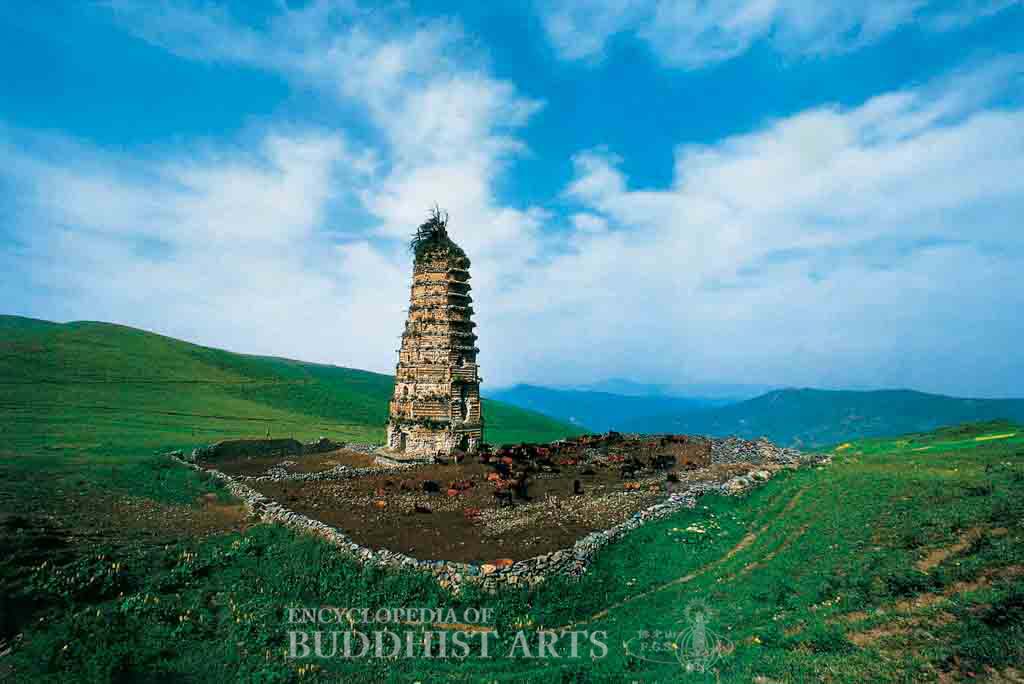
Shiziwo means Lion’s Den. The pagoda was constructed on the grounds of Manjusri Temple in 1599 during the Ming dynasty. The temple no longer exists and only the pagoda remains. It was listed as a Provincial Cultural Heritage Site in 2004.
The 13-story octagonal pagoda is 32 m high. It is hollow and access as far as the fifth story can be gained from the entrance on the east side. The exterior was carved with around ten thousand Buddha images and therefore it was also called Ten Thousand Buddha Pagoda. It was decorated with different yellow, green, and blue glazed ornaments. Next to each Buddha image there are the engraved names of the benefactors. The decorations on the east and northeast sides have been badly damaged. Wind chimes once hung under the corner eaves but no longer remain.
For more details, go to the Encyclopedia of Buddhist Arts: Architecture T-Z, page 1294.
Cite this article:
author = Hsingyun and Youheng and Johnson, Peter and Mankuang and Lancaster, Lewis,
booktitle = {Encyclopedia of Buddhist Arts: Architecture T-Z},
pages = 1294,
title = {{Wutaishan Shiziwo Liuli Pagoda}},
volume = 4,
year = {2016}}