
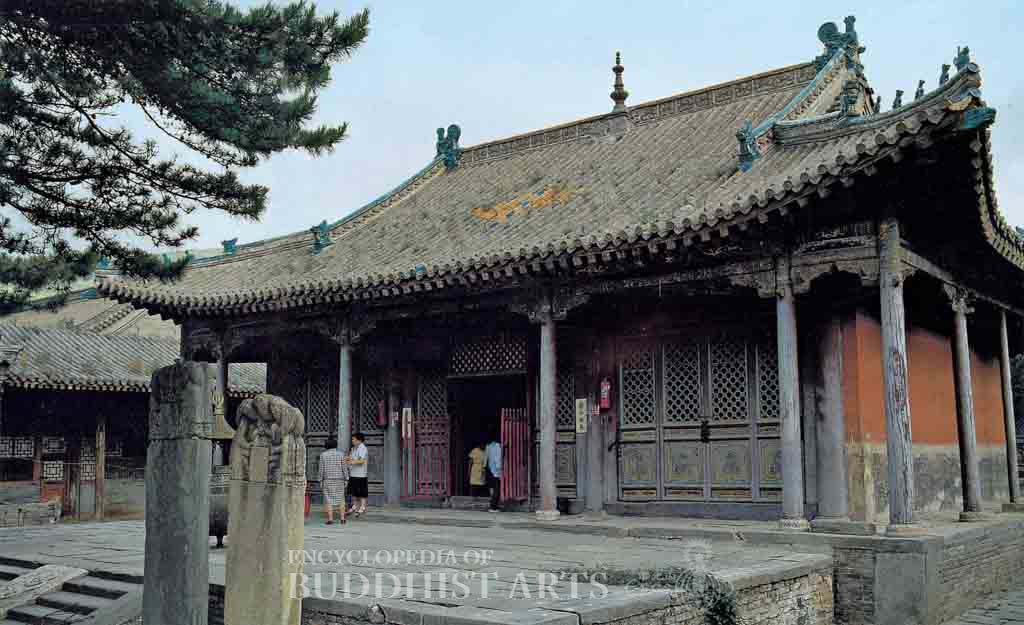
Wutaishan Luohou Temple: Manjusri Hall
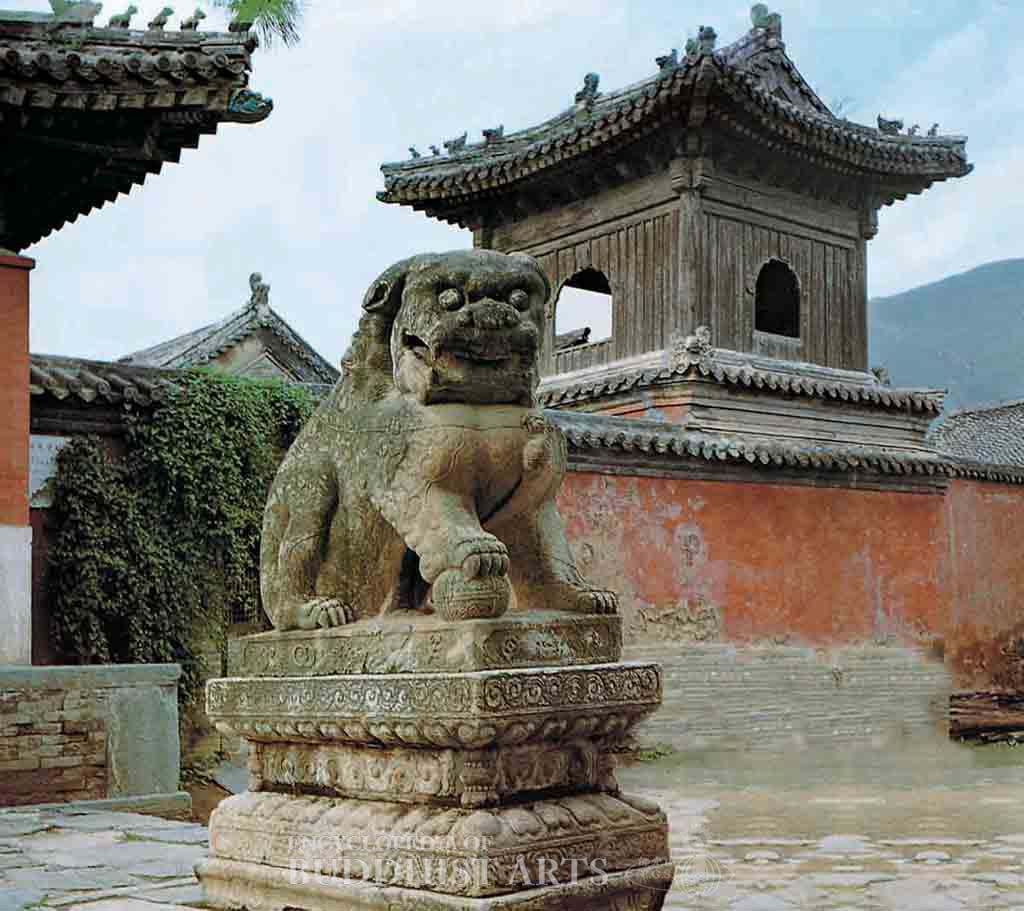
Wutaishan Luohou Temple: Stone Lion
Wutaishan Luohou Temple
CHINA, Shanxi, Xinzhou
Luohou means Rahula. The temple was built during the Tang dynasty (618–907) and named Luofo (Staying Buddha) because, according to legend, Manjusri Bodhisattva once stayed and lectured here. There are no extant structures from the original; it has been repaired and rebuilt a number of times. During the rule of Emperor Kangxi (1662–1722) of the Qing dynasty, it underwent large-scale renovation and was converted from a Chinese to a Tibetan temple. It was listed as a key Buddhist temple in the Han region of China in 1983.
The temple covers 1.5 ha and the buildings along the central axis include the Heavenly King Hall, Manjusri Hall, Great Buddha Hall, and the sutra repository. The Manjusri Hall has a single-eave hip-and-gable roof and contains a Tibetan style statue of Manjusri Bodhisattva riding a lion.
In front of the main temple gate there is a pair of stone lions from the Tang dynasty. Their stone Sumeru bases feature intricate carvings.
For more details, go to the Encyclopedia of Buddhist Arts: Architecture T-Z, page 1290.
Cite this article:
author = Hsingyun and Youheng and Johnson, Peter and Mankuang and Lancaster, Lewis,
booktitle = {Encyclopedia of Buddhist Arts: Architecture T-Z},
pages = 1290,
title = {{Wutaishan Luohou Temple}},
volume = 4,
year = {2016}}