
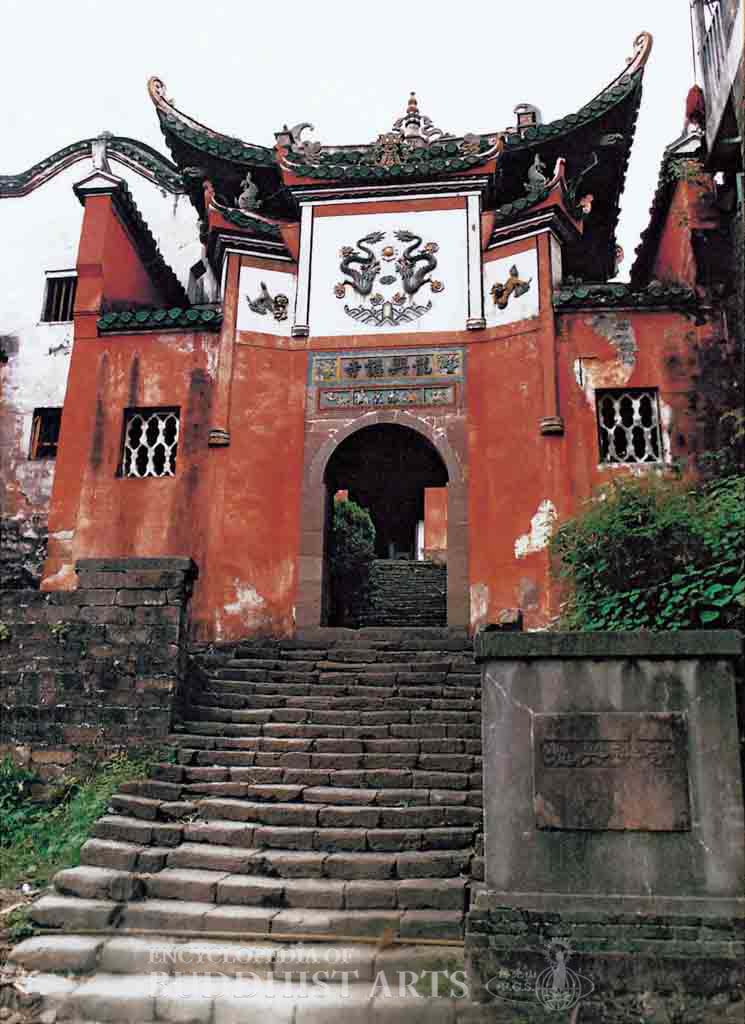
Longxing Temple: Main Temple Gate
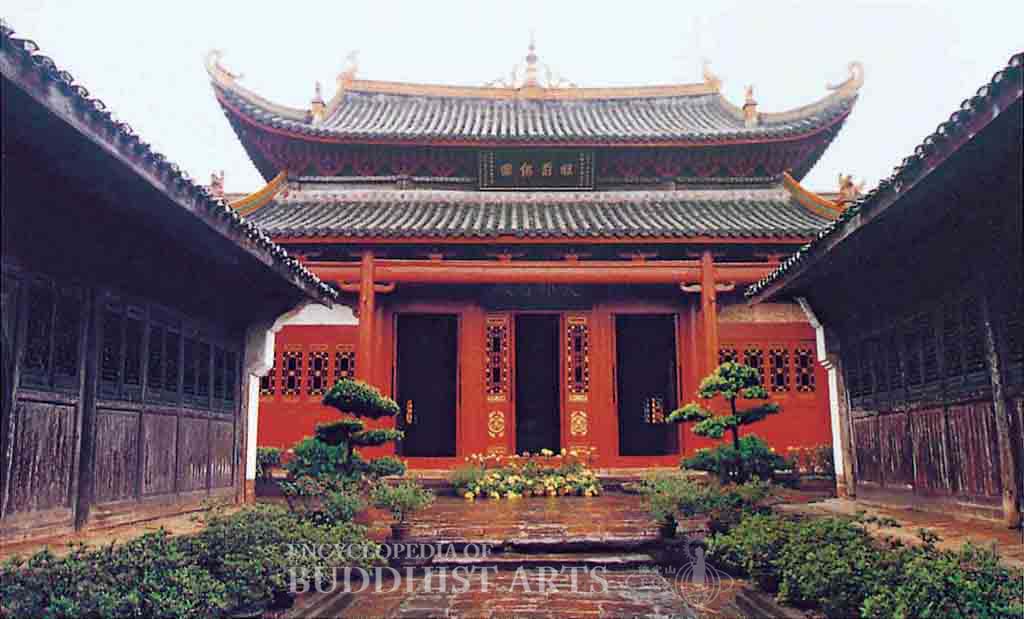
Longxing Temple: Great Hero Hall
Longxing Temple
CHINA, Hunan, Huaihua
The temple is located at the southern foot of Huxishan (Tiger Creek Mountain). It is one of the oldest and best preserved temples in the Jiangnan (region south of the Yangtze River). It was built in 628 during the Tang dynasty. During the Ming dynasty (1368–1644), the famous philosopher Wang Yangming taught here. Extensions and repairs have been carried out on the temple throughout its history. It was listed as a National Cultural Heritage Site in 1996.
The temple faces south and is built on the slope of the mountain. The principal buildings along the central axis include the main temple gate, intermediate hall, Heavenly King Hall, Maitreya Hall, Great Hero Hall, and the Avalokitesvara Pavilion. Along either side there are the Sandalwood Pavilion and the Amitabha Pavilion. The main temple gate has an arched doorway in the center. Above the doorway there are brick illustrations depicting Master Xuanzang’s Journey to Obtain the Sutras. At the very top there are brick engravings of two dragons playing with a pearl, together with aquatic motifs.
The Great Hero Hall has an unusual double-eave roof: the upper part has a hip-and-gable roof, while the lower part has a flush gable roof. The corners of the eaves are upturned. There is a miniature stupa in the center of the main ridge, while at either end there is a dragon. The structure is five bays wide with a wide central bay. The hall is supported by 24 wooden columns, among which there are golden columns with slight tapering at either end. Inside the hall there is an openwork stone lotus throne, which is said to have been created in the Ming dynasty. Structural features such as the upper architrave, crescent beam, bracket sets, and king posts are all characteristic of Song dynasty (960–1279) architecture.
The Sandalwood Pavilion and Amitabha Pavilion are located behind the Avalokitesvara Pavilion, in a triangular formation. The three-bay wide Avalokitesvara Pavilion has two stories and a triple-eave hip-and-gable roof. The upper story contains the sutra repository, while the lower story houses a statue of Avalokitesvara Bodhisattva.
For more details, go to the Encyclopedia of Buddhist Arts: Architecture G-L, page 701.
Cite this article:
author = Hsingyun and Youheng and Johnson, Peter and Mankuang and Lancaster, Lewis,
booktitle = {Encyclopedia of Buddhist Arts: Architecture G-L},
pages = 701,
title = {{Longxing Temple}},
volume = 2,
year = {2016}}