
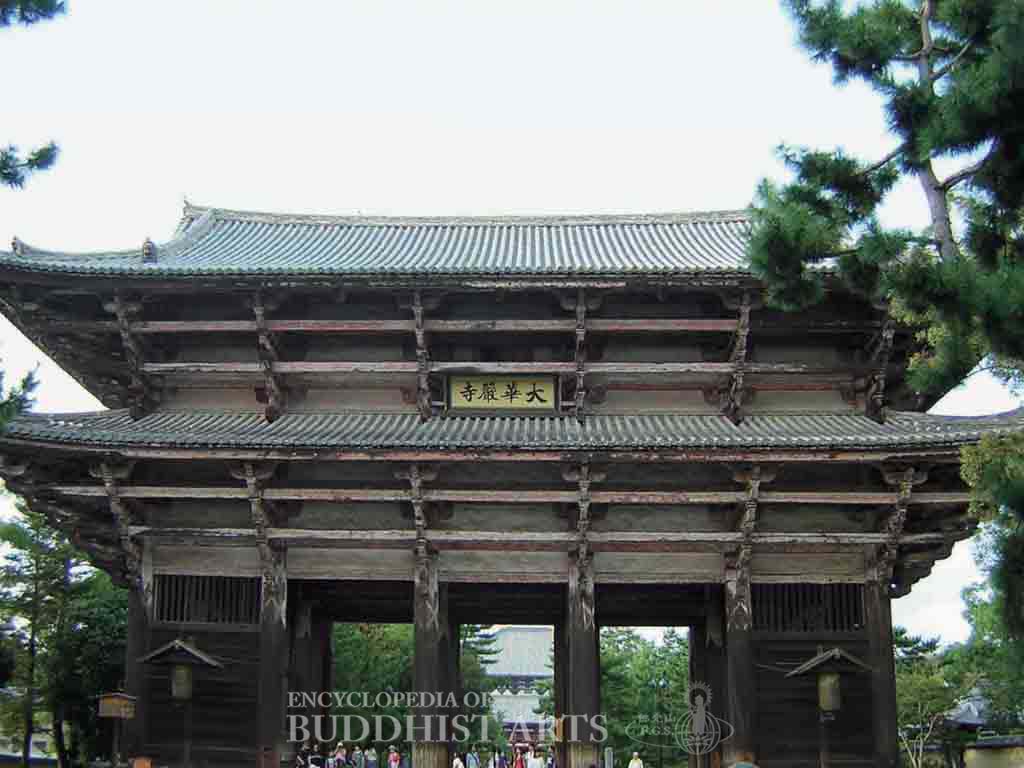
Todaiji Temple South Gate
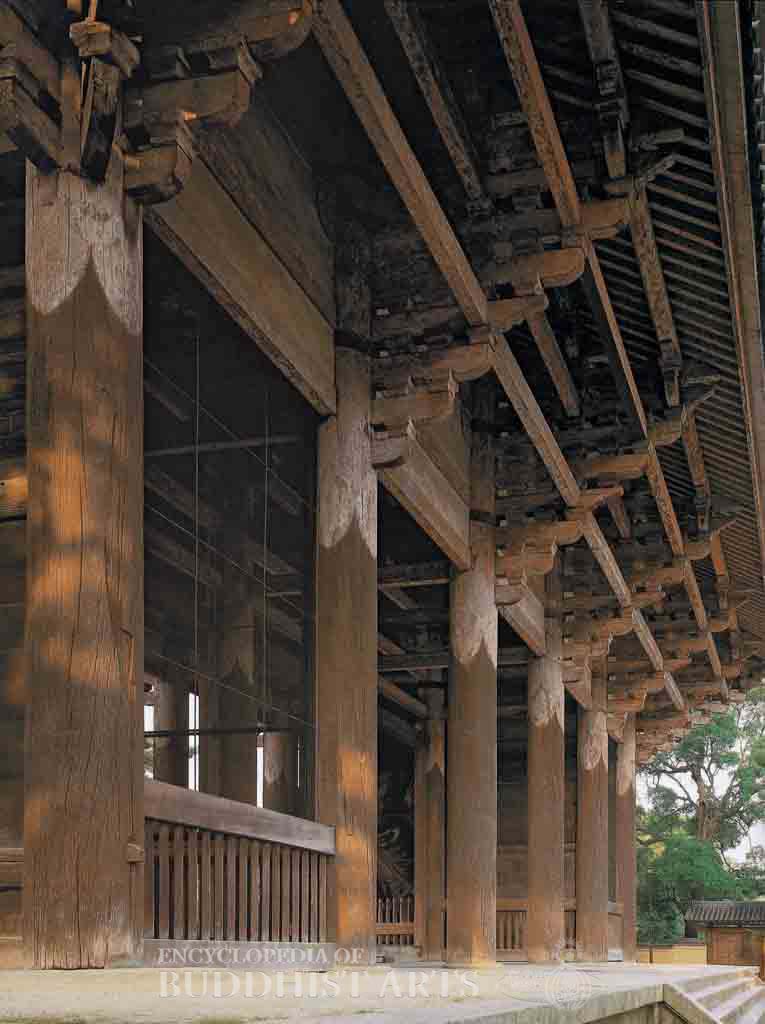
Todaiji Temple South Gate (detail)
Todaiji Temple South Gate
JAPAN, Nara
It is the largest temple gate in Japan. It was built in 762 during the Nara period but destroyed by warfare in 1180 during the Heian period. The current structure was built by monk Shunjyobo Chyogen between 1199 and 1203 during the Kamakura period. It was listed as a National Treasure in 1951.
The 25.5 m two-story gate has a hip-and-gable roof and intermediate eaves covered with cylindrical tiles. The columns, which measure 1 m in diameter and 19.1 m in height, pass through the middle eaves and extend to the roof. There are six-tier bracket sets on both stories. Three-section beams and roof tiles directly over the rafters are used to strengthen horizontal connections. The interior framework of beams is an important element reflecting the architectural style of main halls during the Kamakura period (1185–1333). The statues of guardian figures on either side of the gate are excellent works of Unkei and Kaikei, and are the largest pair of Vajrapanibalin statues in Japan.
For more details, go to the Encyclopedia of Buddhist Arts: Architecture T-Z, page 1138.
Cite this article:
author = Hsingyun and Youheng and Johnson, Peter and Mankuang and Lancaster, Lewis,
booktitle = {Encyclopedia of Buddhist Arts: Architecture T-Z},
pages = 1138,
title = {{Todaiji Temple South Gate}},
volume = 4,
year = {2016}}