
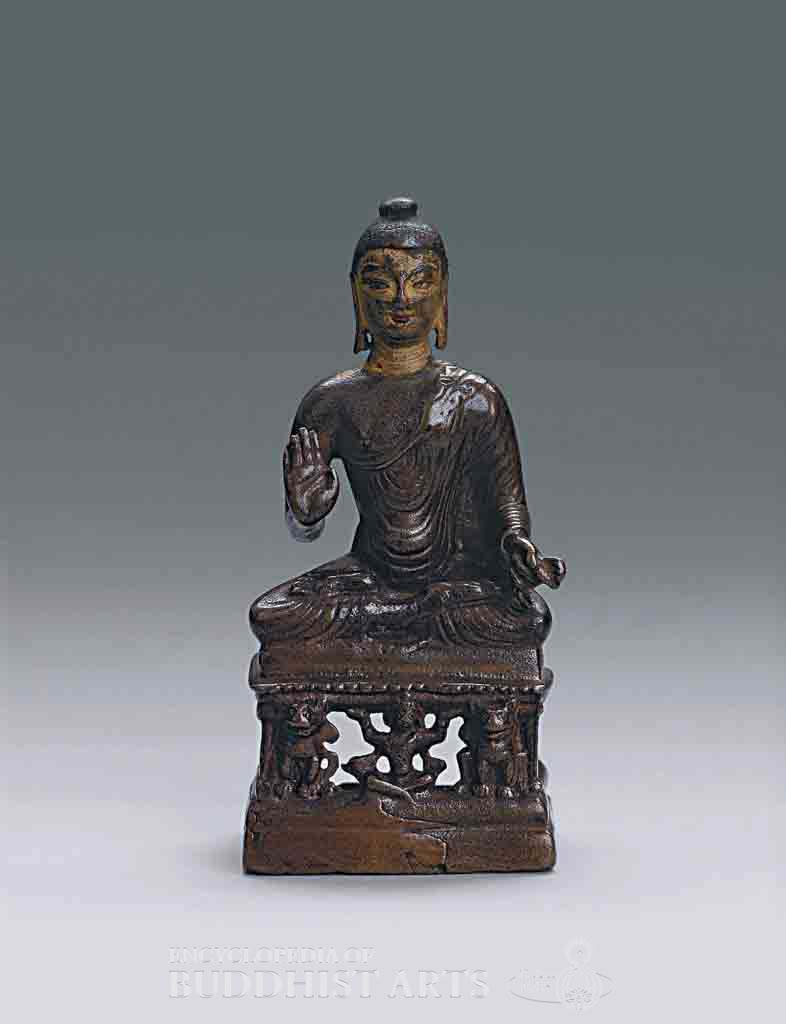
Wangdue Phodrang Dzong: Seated Buddha
Brass
Wangdue Phodrang Dzong: Seated Buddha
BHUTAN, Wangdue Phodrang
The work is of Kashmiri origin, a place that was in close proximity to the Gandhara region. After the 5th century, it had combined the Gandhara and Gupta styles to develop its own style, which featured more rounded curves and had a preference for casting in bronze.
The Buddha wears a close-fitting monastic robe that leaves the right shoulder bare. The right hand is raised in abhaya (fearlessness) mudra, while the left hand grasps a fold of the robe. The figure is seated in full lotus posture on a square cushion resting on a openwork throne. A pair of lions supports the corners of the throne, while between them is a cross-legged yaksa also bearing the load on upraised hands, a feature originally deriving from Bharhut sculptures. Using yaksas as a support is rare in Buddhist art.
For more details, go to the Encyclopedia of Buddhist Arts: Sculpture St-Z, page 1315.
Cite this article:
author = Hsingyun and Youheng and Lovelock, Yann and Chou, Yuan and Huntington, Susan and Edson, Gary and Neather, Robert,
booktitle = {Encyclopedia of Buddhist Arts: Sculpture St-Z},
pages = 1315,
title = {{Wangdue Phodrang Dzong: Seated Buddha}},
volume = 13,
year = {2016}}