
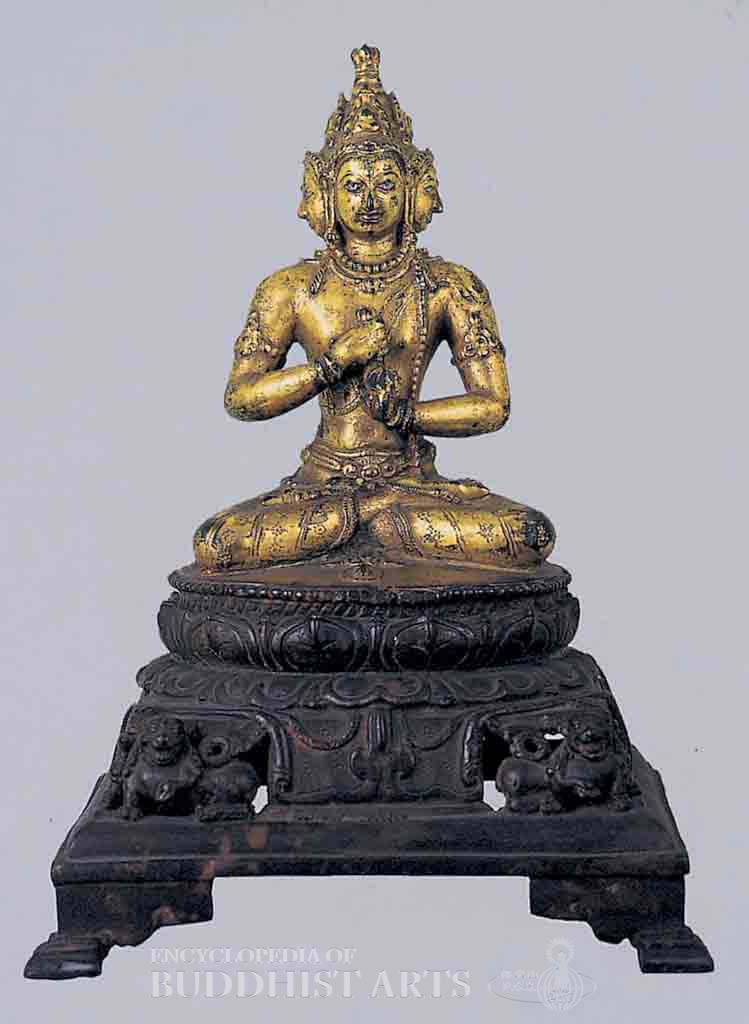
Nalanda: Four-Headed Vairocana
Gilt copper alloy
Nalanda: Four-Headed Vairocana
INDIA, Bihar
The statue was unearthed from Nalanda and is dated by its stylistic details characteristic of the late 11th century of the Pala period (circa 8th–12th century). The hair of the Four-Headed Vairocana is piled beneath a single crown and decorated with a vajra at the crest. A vajra is also supported between the two hands in place of the usual bodhyangi (wisdom fist) mudra by which this figure is usually identified.
Vairocana’s bare upper body is decorated with a variety of jewelry that includes a belt with pendants to secure the flower-patterned skirt. The Buddha is seated in full lotus posture on a double lotus throne that is supported on a metal pedestal. Each corner of the throne is guarded by a lion. In addition, a lotus, a jewel and two kinds of vajra are placed between garlands on each side.
For more details, go to the Encyclopedia of Buddhist Arts: Sculpture N-Sr, page 750.
Cite this article:
author = Hsingyun and Youheng and Lovelock, Yann and Chou, Yuan and Huntington, Susan and Edson, Gary and Neather, Robert,
booktitle = {Encyclopedia of Buddhist Arts: Sculpture N-Sr},
pages = 750,
title = {{Nalanda: Four-Headed Vairocana}},
volume = 12,
year = {2016}}